Provider Pricing Tiers and Rate-Limit-to-Cost Relationships
Hidden rate limits and cost structures hit hardest when your traffic spikes.

Pricing tiers look like a budget decision. Pick the plan that fits the spend, move on. Tiers also set rate limits, concurrency ceilings, and priority queuing, and those constraints don't appear on the pricing page. They appear during a traffic spike, a product launch, or an incident, at the exact moment a team can least afford to discover them. This piece is about reading tier structures as throughput contracts, not just cost menus, so the constraints get planned around instead of stumbled into.
How LLM API pricing spans four orders of magnitude, and what that range represents
Model pricing right now runs from about $0.03 per million input tokens on the cheapest paid models up to $10 per million on flagship models like Claude Fable 5.1, with output pricing running proportionally higher, roughly three orders of magnitude between the floor and the ceiling. Model pricing right now runs from about $0.03 per million input tokens on the cheapest paid models up to $10 per million on flagship models like Claude Fable 5.1, with output pricing running proportionally higher, a difference of four orders of magnitude between the floor and the ceiling. That's four orders of magnitude between the floor and the ceiling.
The gap isn't noise. It maps to real differences in capability, in how much compute a provider is willing to set aside for a request, and in how much priority access a customer is paying for. The cheapest production-grade models, the ones scoring 70 or above on common benchmarks, cost around $0.75 input and $3.75 output. Below that line, quality drops off fast enough that most teams won't ship on it.
At the top, Claude Fable 5.1 runs $10/$50 per million tokens. GPT-5.6 Sol costs around $4 to $5 input and $20 to $30 output depending on the deal. Claude Opus 5 costs $5/$25. These aren't just the expensive options on a menu. Providers design these tiers to get priority compute allocation: the price buys faster, more reliable access, not just a smarter model. In the middle, Sonnet 5 at $2/$10 and Gemini 3.1 Pro at $2/$12 offer a working compromise: capable enough for most production tasks, without flagship pricing.
What rate limits measure, and why tokens, not requests, are the unit that matters
Traditional API gateways count requests. One call in, one call counted, regardless of what's inside it. LLM providers don't work that way. Their rate limits run on multiple axes at once, most importantly tokens per minute alongside requests per minute, and the token axis is usually the one that bites first.
A single request to an LLM endpoint can carry anywhere from 50 tokens to 50,000 tokens. Two calls to the same model, same endpoint, same customer, can differ in cost and compute load by three orders of magnitude. A short classification prompt and a long document-summarization call look identical to a request-counting gateway. They look nothing alike to a token-counting one.
That mismatch creates a specific failure mode: a team can sit comfortably under its requests-per-minute limit while slamming into its tokens-per-minute ceiling. The tighter constraint throttles the app, and it's often the one nobody's watching, because the dashboard shows request volume, not token volume.
OpenAI's tier ladder linking cumulative spend to rate-limit access
OpenAI's tier system runs on cumulative spend, not negotiation. OpenAI's tier 1 starts at $5 in lifetime purchases. At $40, tier 2 kicks in. Tier 3 at $200. Tier 4 at $400. Crossing each threshold makes rate limits jump automatically, with no sales call required.
That sounds convenient until a team hits the edge of it. Throughput rights are a function of past spend, not future intent. A team ready to spend a substantial sum a month starting tomorrow still gets throttled at Tier 1 limits until the cumulative total crosses each gate. The constraint is retrospective: it looks backward at what's already been paid, not forward at what's coming.
Model fallback adds another wrinkle that's easy to miss. OpenAI's GPT-5.4 Thinking falls back to GPT-5.4 mini for paid users once rate limits are hit. That means the model actually serving a request may not be the model the request was addressed to. A prompt engineered and tested against the full Thinking model can quietly start running on mini under load, with no error thrown and no obvious signal beyond a shift in output quality.
Discount structures and their interaction with tier constraints: caching, batching, and volume terms
Three discount levers show up across most providers: cached input, batch processing, and cheaper model tiers. Each comes with fine print, and none of it applies uniformly across every tier or every model.
Cached input runs around 10% of the standard input rate. That's a real discount, but it only pays off if the prompt structure is built to hit the cache. Static system prompts, repeated context blocks, consistent formatting: these are the things that make caching work. A team that restructures its prompts around cache boundaries can watch effective input costs drop by most of an order of magnitude. A team that doesn't won't see the benefit just by being on a higher tier.
Batch processing runs about 50% off, but only for jobs that can wait. Async workloads, background enrichment, classification pipelines, evaluation runs: batch pricing changes the math substantially for all of these. It's useless for a live chat interface where a user is staring at a loading spinner. The discount exists, but it's gated by a use-case constraint that has nothing to do with which tier an account sits on.
The cheapest model for a task versus the cheapest model by token price
Defaulting to the cheapest model per token is a fine instinct until it ignores what happens on the specific task at hand. Price per token and price per correct answer are not the same number, and treating them as interchangeable is where teams lose money while thinking they're saving it.
Documented cases cut both ways here. Smaller models have in some cases matched or exceeded their larger siblings on well-structured extraction tasks. Cheaper models have outperformed pricier alternatives on context-heavy classification work. Smaller and cheaper doesn't always mean worse, and bigger doesn't automatically mean better fit for a narrow, well-defined job.
The real metric is cost per correct, usable output, not cost per token. A model that's three times cheaper but doubles the retry rate, or produces outputs that need a human or a second model pass to fix, isn't actually cheaper. It just moves the cost somewhere less visible.
Context length adds one more variable that flat per-token comparisons miss. Gemini 3.1 Pro prices at $2/$12 per million tokens, but that rate applies to shorter prompts. Pushing past the 200K-token threshold raises pricing to $4/$18. A routing system built on a single price assumption per model, without accounting for prompt length, will misestimate cost on every long-context call it makes.
Failure modes teams encounter when production load meets tier ceilings
Hitting a rate limit causes the provider to return a throttling error, typically HTTP 429. The application has to handle that gracefully, or the end user just sees a failed request. There's no middle ground.
Without something sitting between the app and the provider, that handling logic, retries, exponential backoff, fallback to a secondary model, has to get built into the application code directly. And it tends to get built inconsistently: one service handles 429s with a clean backoff, another just lets the error surface to the user, a third retries immediately and makes rate limiting worse.
Provider outages stack a second failure mode on top of the first. When a primary provider degrades, traffic shifts to a backup, and that backup may sit on a lower tier with tighter limits than the team expects. The fallback route can hit its own ceiling faster than anyone planned for, precisely at the moment it's carrying the full production load alone.
Enterprise AI adoption crossed 80% in 2026, and at that scale, wiring an application directly to a single provider's API stops being a viable long-term architecture. Fragmented APIs across providers, inconsistent rate-limit behavior, and outages that cascade from one provider into another's overloaded backup path: these are the default outcome of direct integration at scale, not an edge case.
How an LLM gateway translates tier awareness into routing decisions
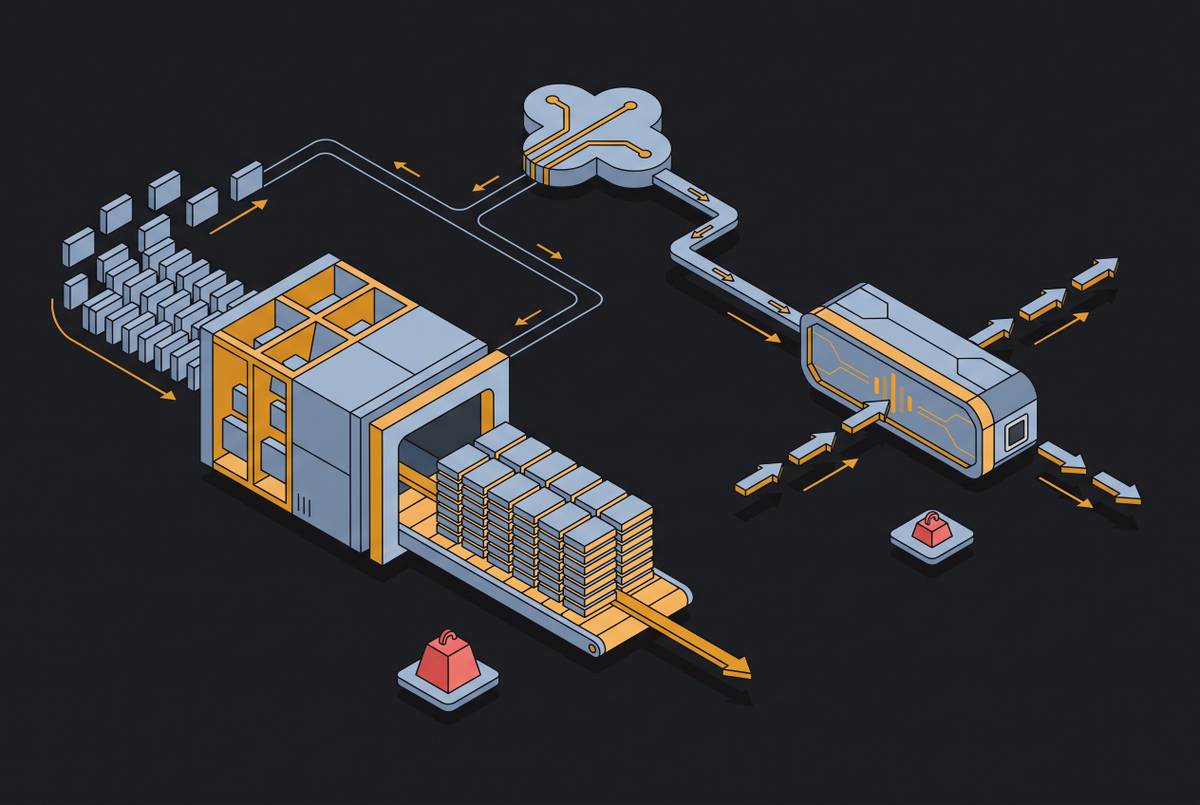
A gateway sits between the application and the providers, giving the app one consistent endpoint to call while the gateway handles routing, failover, rate limits, access control, and cost tracking underneath it. The application code doesn't need to know which provider or which tier is serving a given request.
This is the layer where tier-awareness turns into something enforceable rather than something discovered after the fact. A gateway can track per-provider rate-limit budgets in real time, notice when a provider is approaching its ceiling, and reroute traffic before a 429 ever reaches the application.
Token-based rate limiting at the gateway level caps consumption by tokens processed, not by requests counted, which controls spend in proportion to what's actually being charged.
From there, a gateway opens up a handful of concrete routing patterns:
- Cost-optimized routing, sending routine or low-stakes tasks to cheaper models while reserving flagship-tier spend for the tasks where the quality gap actually justifies the price.
Latency-based routing shifts traffic away from a provider that's gone slow, not just one that's gone fully down.
- Fallback chains, so a tier ceiling on the primary provider triggers a defined secondary path instead of an error bubbling up to the user.
- Load balancing across multiple keys or provider regions, spreading traffic to stay inside tier limits instead of stacking it all on one account.
None of that requires touching application code once the gateway's in place. The routing logic lives in one layer, instead of scattered across every service that happens to call an LLM.
Governance and spend visibility requirements for sustainable tier decisions at the gateway layer
Worldwide spending on AI models and platforms is set to grow 63% in 2026, reaching $64 billion. For most companies, that entire amount lands as one line item on a vendor invoice. No breakdown by team, by product, by workflow. Just a number.
That's the attribution gap, and it's the reason cost keeps coming up as the top complaint around AI adoption. In Jellyfish's survey of 636 engineering leaders, rising AI tool costs emerged as a leading adoption challenge. Without knowing which workload is driving spend, a team can't tell which one is also driving tier pressure, or which one will blow through a rate limit first.
Real visibility at the gateway layer means a few specific things, not a dashboard with pretty charts:
- Cost attribution broken out per model and per provider, tracked as it happens, not reconstructed weeks later from an invoice.
- Token consumption tracked per team and per project, so whichever team is responsible for 80% of spend is visible before that spend exhausts the tier, not after.
- Budget alerts paired with hard caps by team or use case: not just a warning email, but an enforced limit that actually stops the spend before it runs away.
Anomaly detection on token use means a retry loop stuck in a bad state or an agent misfiring in a loop triggers an alert immediately, instead of appearing as a surprise on next month's bill.
Tier selection without this layer is a guess dressed up as a plan. With it, tier and routing decisions become something a team chooses on purpose, based on actual numbers, instead of something they find out about the hard way, mid-incident, with a queue of failed requests piling up behind a 429.