Audit Logging and Data Lineage for LLM Request Traffic
Standard logs miss the moments that matter most in LLM audits.
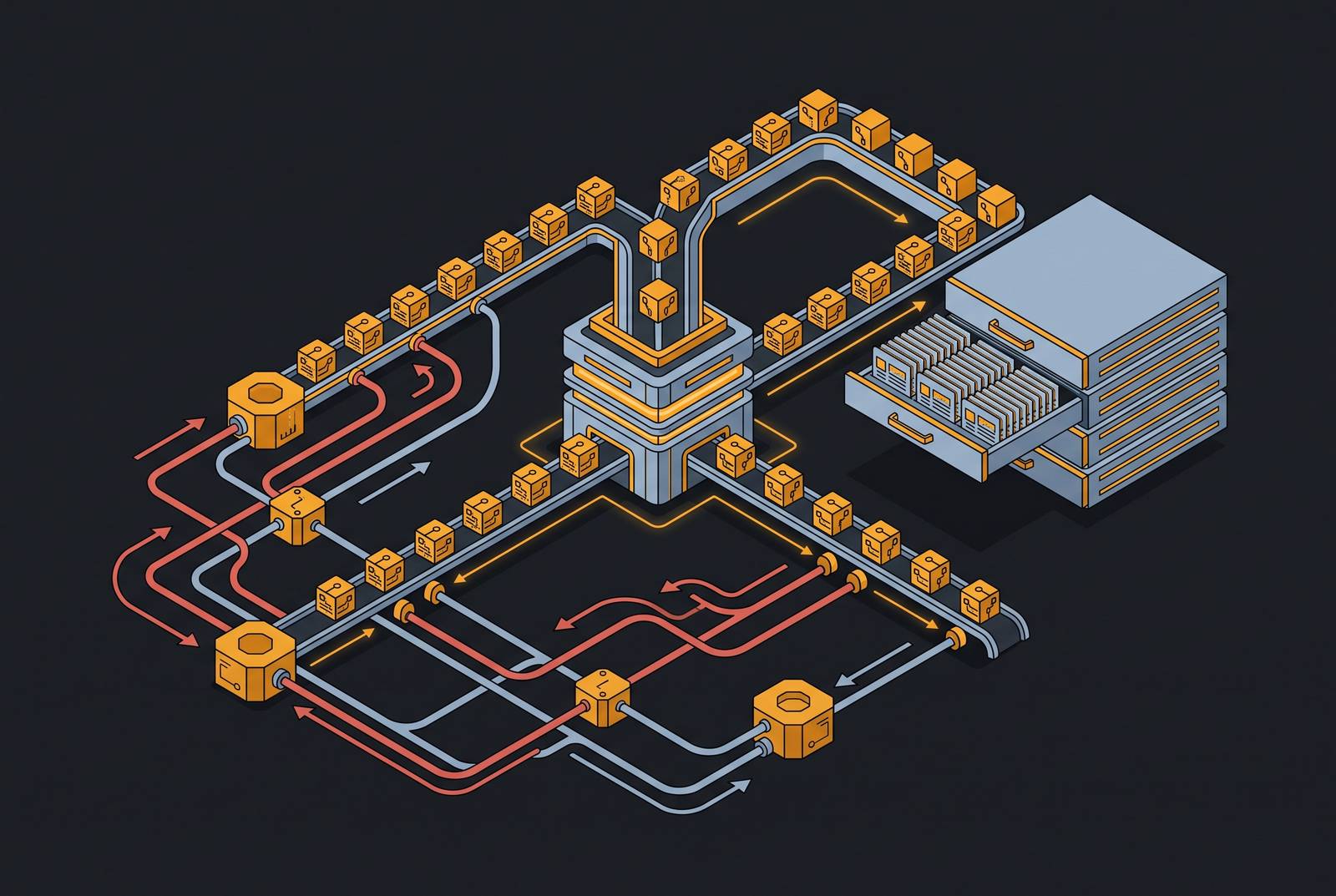
A team that trusts its existing application logs to cover LLM traffic will find the gap exactly when a compliance question arrives, and by then the record they need is already gone. Standard application logging was built for a different kind of interaction. It records authentication events, API calls, file access, and error states, and for most enterprise tools, that's enough to establish who did what and when.
LLM interactions break that model in two ways that have nothing to do with log volume and everything to do with where the sensitive moment actually happens. First, data exposure happens through input, not output. When someone pastes a contract excerpt into a prompt, that data has already left the building before any response comes back, so a logging system built to watch outputs never sees the moment that mattered. Second, LLM tools work through context windows, so they build up information as a conversation goes on. If a system logs each turn on its own, and never ties those turns together into a session, it misses the cumulative picture an investigator actually needs.
The log looks complete and isn't, a gap that surfaces only when someone needs it to hold up. Teams don't discover the shortfall during instrumentation or code review. They discover it when a regulator, auditor, or internal compliance officer asks a specific question and the answer simply isn't in the record. Even where monitoring tools collect the right raw data, it often sits in a format you have to manually extract before it works as evidence a compliance team can use. That's a structural problem, not a matter of logging more.
What a compliance-ready LLM request record contains, field by field
A compliance-ready LLM audit record is a different kind of artifact, built from fields that standard logging was never designed to capture.
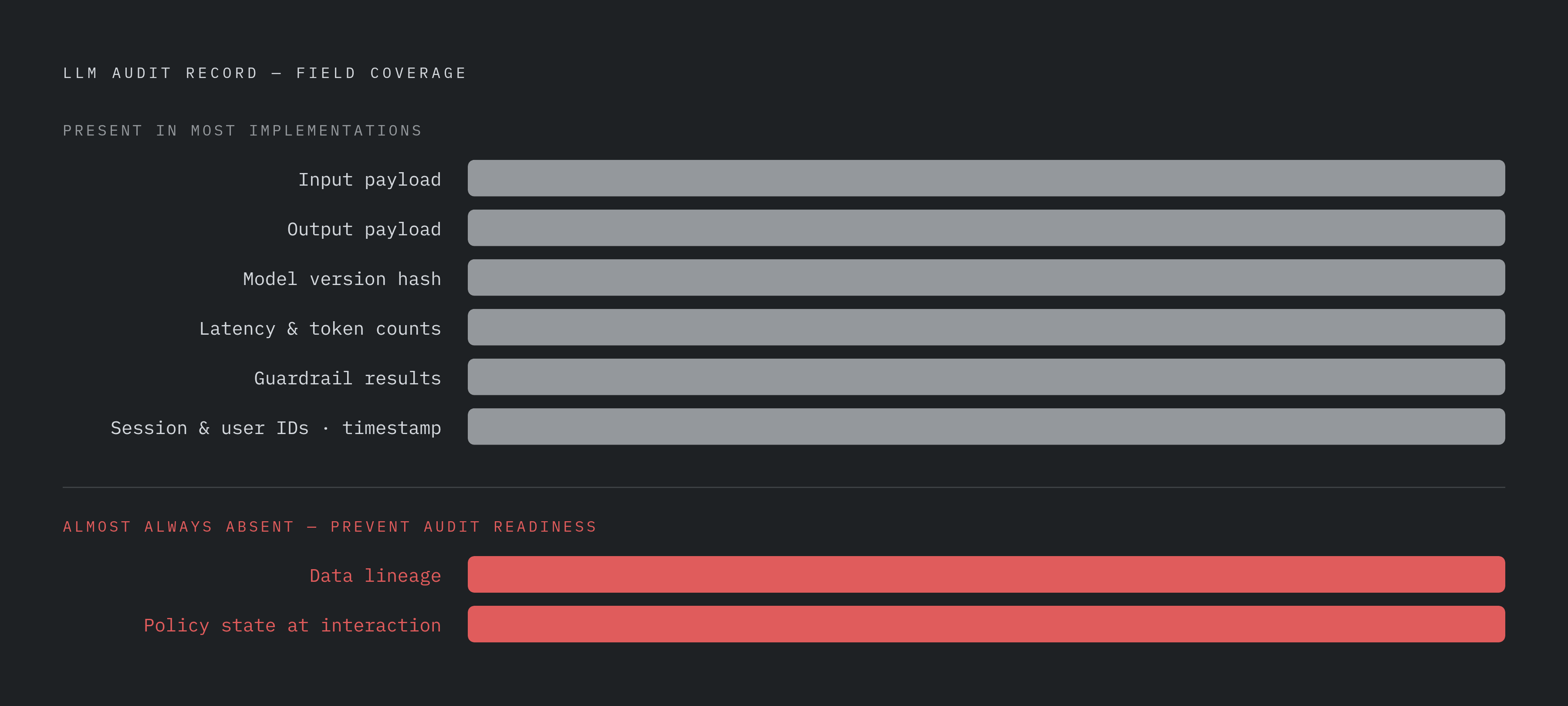
Start with the input payload: the exact prompt text, system instructions, and user context passed to the model at inference time. This satisfies data handling documentation and input audit trail requirements, and it's the field that output-only logging skips. The output payload matters just as much: the raw model response, captured before any post-processing strips or reformats it. This supports output review records and harm assessment evidence.
Model version hash comes next: an immutable identifier of the exact deployed artifact that generated a given response. This satisfies change management and version control documentation, and it answers a question that comes up constantly in incident reviews: which version of the model actually produced this output. Latency and token counts cover request timing and input and output token volumes, so you get performance monitoring and cost accountability from them.
Guardrail evaluation results record a pass or fail on every safety or quality check run against a request, and they keep the scores behind each decision too. These satisfy policy enforcement logs and threshold compliance records. Session and user identifiers link individual turns across a multi-turn interaction, so you can build user-level audit trails and answer data subject access requests. Timestamp, recorded in UTC at the moment of inference, supports event sequencing and regulatory incident timelines.
Two fields get left out of most implementations, and their absence is what keeps an investigation from reaching a conclusion. Data lineage tracks the source file or application that the input content started from. Policy state at time of interaction records which rules were active and whether any of them triggered during that specific request. If it's missing, you can't tell from a log entry whether the system's behavior stayed within approved bounds at the moment it happened.
Regulatory Evidence Obligations for These Fields
Regulatory frameworks don't ask whether an LLM system felt reliable. They ask for records showing what the system received, what it returned, under what conditions, and whether its outputs stayed within defined boundaries over time.
The NIST AI RMF spells this out directly: its documentation requires that the effectiveness of applied metrics and processes be assessed and documented. If a trace record doesn't name specific metrics and threshold values, the framework's Measure function is left incomplete. The RMF's four functions, Govern, Map, Measure, and Manage, each require their own documented evidence. Observability data maps onto two of them directly: Measure, through metric scores and drift indicators, and Manage, through incident records, remediation actions, and threshold adjustments. A gateway that logs guardrail scores and policy triggers is generating Measure and Manage evidence by default, whether or not a team has labeled it that way.
The EU AI Act sets a parallel obligation. Article 12 requires that high-risk AI systems technically allow for automatic recording of events over the system's lifetime, a requirement scoped specifically to high-risk systems. Article 43 then governs how conformity gets assessed: providers of certain high-risk systems choose between internal control or a notified body's review. None of these obligations are satisfied by a summary report generated after the fact.
The structural gap is this: trace data alone doesn't satisfy an auditor. Auditors want a direct line from a specific model decision to the evidence that the decision was monitored, assessed, and kept within approved boundaries. If a high proportion of requests passed guardrail checks on an aggregate dashboard, that still doesn't answer the question an investigator asks about one specific request. Only inference-level records, the kind described in the previous section, answer that question.
The Session Thread as the Unit of Lineage
The basic unit of LLM data lineage is the session thread, not the single API call, and most logging systems are built around the wrong one. A log that captures every individual request in isolation can still miss the pattern that only becomes visible when those requests are read together.
Consider how this plays out in practice: a user might share something entirely benign in the first turn of a conversation, then introduce sensitive context three or four turns later. A system that ties both turns to a session identifier preserves the fact that they belong to the same conversation, and that connection is often what an investigation is actually looking for.
Session-level capture asks for a few things that per-request logging alone doesn't provide. A thread or session identifier has to link every turn in a multi-turn interaction. Cumulative input tracking has to follow the full context window as it builds, not just the most recent message sent to the model. Sensitivity classification has to run at the session level too, since classifying each turn on its own can miss a pattern that only becomes visible once the turns are read in sequence.
Session-level lineage also has to track where pasted or uploaded content originated. The chain connecting an originating file to its eventual use as AI input converts a log entry into something an investigator can act on, giving a timestamp context behind it. This matters even more in agentic systems, where one user action can trigger a chain of several model calls across different tools and steps. Span-level telemetry that rolls up into the full agentic hierarchy turns the log into a record of decision lineage, not a flat list of disconnected events, and the session-level view is the only one that reconstructs what actually happened across that chain.
Where in the Stack These Fields Must Be Captured
What to log and where to capture it are the same question, not two separate ones. When instrumentation is left to individual development teams scattered across an organization, fields that look easy to collect at the application layer tend to come out inconsistent, incomplete, or missing.
Application-layer logging has three structural weaknesses when it comes to LLM traffic. And it puts the burden of maintaining compliance instrumentation on every development team, a governance cost that grows with every new application added to the stack.
Standard application logging infrastructure was built for a different interaction model, so when you retrofit it to capture LLM-specific detail, particularly data lineage and session context, you often end up building custom logging at the application layer from scratch. A gateway-first approach sits at the inference boundary instead, the point where these fields naturally accumulate anyway. Input payload, session identifiers, token counts, and policy state at time of interaction can all be captured once and logged consistently across every provider call, which removes the need for instrumentation logic scattered across dozens of codebases. Audit-grade tracing needs the full request, response, prompt version, model version, scorer results, and timestamps, with export to SIEM and BI tools in formats like Parquet or JSON Lines for external review. That requirement points to a layer that sees the entire request, not a slice of it filtered through whatever logic a given application happens to run.
Gateway-First Architecture and Complete Audit Records
A gateway sits between applications and model providers, so it sees every field a complete audit record needs, and no application team has to write custom instrumentation. That's the structural advantage: one control point, crossed by every request, regardless of which team or application sent it.
At that control point, several things get captured automatically. The full input and output payloads, before and after any provider-side processing. The model version and provider actually selected, including any routing or failover decisions made along the way. Token counts, latency, and cost, attributable down to a team, project, virtual key, or end user without separate analytics work bolted on afterward. Guardrail evaluation results, where guardrails run at the gateway itself. And the policy state active at the time of the request, including exactly which rules were evaluated and which ones triggered.
The two fields most implementations omit, data lineage and policy state at time of interaction, are precisely what separate a logged record from an audit-ready one, and they're easiest to capture at the gateway layer, where every request already passes through a single enforcement point. Logging these fields at the moment of inference turns a plain request record into evidence a regulator can trace from a specific model decision back to the approved bounds that decision was supposed to respect.
Access control at the gateway layer governs who can view, export, or act on these logs. Concentrate, as an LLM gateway, applies RBAC, SSO, and audit logging along these lines, alongside SOC 2 Type II compliance and zero data retention, giving teams a concrete example of what gateway-layer governance looks like in production.
Stopping PII and PHI From Reaching Model Providers
Where redaction runs in the request path is an architectural decision with a binary outcome: either sensitive data crosses the organization's network boundary before it gets scrubbed, or it doesn't. There's no middle setting here. A team asking how to prevent patient data from reaching a model provider, or how to keep PII from leaving its infrastructure when employees use an LLM through an API, is really asking where in the pipeline redaction happens, because that location determines the answer.
Client-side or application-layer redaction only works if every single application runs it consistently, which runs into the same inconsistency problem that undermines application-layer logging generally: one team misses a field, one service skips the step, and unredacted data slips through. Redaction inside a managed vendor's infrastructure still leaves data exposed, because the unredacted input has already crossed the network perimeter to reach that vendor before any scrubbing takes place. Gateway-layer redaction, run on infrastructure the organization itself controls, is the only pattern that keeps unredacted content inside the network perimeter the entire time.
When sensitive data like PII or other protected personal data flows into a prompt, audit readiness depends on knowing what data entered the system and whether it was handled under the right controls. A gateway-layer vantage point lets you enforce, and log, policies and redaction rules before a request ever reaches a model provider, so it creates an immutable record regulators can follow from intake straight through to inference.
Redaction also has to be reviewable, not just present. If a redaction rule strips data silently, and never logs what it removed, you don't get audit evidence from it. It produces a gap in the record, sitting exactly where evidence was supposed to be.
Making audit logs usable: immutability, retention, and export to the tools that consume them
If a log captures every right field but can't be exported, queried, or proven unaltered, it is a data store that needs more work before it functions as evidence anyone can rely on.
Immutability has to be built into the system, not bolted on as a setting flipped later. A log that can be edited after it's written fails the append-only requirement that compliance frameworks are built around.
Retention has to be decided at instrumentation time too, not reconstructed under pressure during an audit. Applying one retention rule across every log type creates its own problem: low-sensitivity records get held longer than necessary while high-sensitivity ones get purged too soon.
Export format decides which downstream tools can use these logs without you converting them first. Logs that export to SIEM and BI tools through formats like Parquet or JSON Lines support external audit review directly. A proprietary format locks a team into one vendor's tool, so it creates dependency risk and slows down incident response exactly when speed matters most.
Three groups consume these logs, and each needs something different from them. Security teams need real-time access to session-level records and policy trigger events so they can investigate incidents as they happen. Compliance and legal teams need point-in-time snapshots with regulatory field mappings and proof that the log itself hasn't been altered since it was written.
A gateway-first logging architecture that captures the right fields, enforces immutability at ingestion, and exports in open formats turns a compliance obligation into infrastructure that security, finance, and legal teams can all draw from, each reading the same record for what it needs.