System Prompt Versioning and Token Overhead in Production
Untracked prompt changes quietly inflate costs and hide production failures.

Every time an application calls a language model, the full system prompt goes out with the request. Not a reference to it, not a pointer, the entire text, re-tokenized and billed at the full input rate. It doesn't matter if the prompt is identical to the one sent a second ago. The provider doesn't know that, and it charges for every token it counts.
That single fact is the whole starting point here. A system prompt is a cost paid on every single call, forever, for as long as that prompt stays in production.
How much that costs depends on the shape of the exchange. If the system prompt runs long and the user's message runs short, the prompt is where the money goes. A short user query sitting under a few thousand tokens of instructions means most of the bill comes from instructions. With a long user input and a short prompt, the ratio flips and the prompt's share shrinks. Cost structure here is mostly about this ratio, not about which model is cheapest per token.
There's a second layer that teams rarely account for: the same prompt text can cost a different amount tomorrow than it does today, with no one touching it. Anthropic states Claude Opus 4.7 may use up to 35% more tokens on the same fixed text than older model versions. A tokenizer change alone, something that happens on the provider's side with no warning, can shift the token count of a completely untouched prompt. A team budgeting off last quarter's numbers can find this quarter's bill is materially higher, for a prompt nobody edited.
How production prompts grow without a record
Prompts don't stay the size they started at. Engineers patch an edge case here, append a policy clause there, add a worked example to fix one bad output. Each change is reasonable in isolation. Over months, these additions pile up until the prompt looks nothing like the one that shipped on day one.
The sinc-LLM paper tracked this pattern across real production agents. One multi-agent system started at a few thousand tokens per request and reached tens of thousands within months, with no single dramatic change responsible. Across a large set of observations, the paper found that 97% of tokens in these bloated prompts were pure noise: content sitting in the prompt that did nothing to improve what the model produced.
Most teams running one of these systems can't say when the prompt crossed from lean to bloated. The growth happened in dozens of small, unlogged edits. Nobody wrote down the size at each step, so the only state anyone can point to is the current one. There's no before to compare it against.
The invisibility is built into how the billing works. Token counts get folded into one total input-token line on the invoice. Growth in prompt size never appears as its own number anywhere, so the bill rises without pointing to the reason. The cost rises and the cause stays hidden inside a total.
The same blind spot occurs on the reliability side as well as the cost side. In most LLMOps setups, the model is actually the component that changes least often. Prompts change constantly, sometimes weekly, sometimes daily. A prompt that worked fine last week can start producing worse output this week because the model provider quietly updated the base model underneath it, even though no one touched the prompt itself. Every prompt edit is a production deployment. It needs the same tracking, testing, and ability to reverse course that any other deployment gets, and most teams don't give it that.
Treating a Prompt as a Versioned Artifact in Practice
Prompt versioning means something specific: assigning a stable, unchangeable identifier to a prompt the moment it changes, and attaching that identifier to every production trace the prompt produces. Saving a prompt as a text file, or storing it in a database table, is not the same thing. A file can be opened and edited. A version can't.
Without that discipline, a change to a system prompt is a production deploy with no commit SHA behind it. The failures this produces aren't usually dramatic. A support bot starts quoting the wrong refund policy. A JSON extraction step starts dropping a required field. An agent's planning step picks the wrong tool because a system instruction got moved below the examples when it belonged above them. When a compliance reviewer goes looking for what caused it, the trail ends at "someone changed the prompt," with no further detail available.
Treating a prompt as a versioned artifact fixes this through a few specific commitments. The prompt text behind a version identifier is immutable: once it's live, it can't be edited in place, and any change produces a new version with its own identifier. Every dynamic slot in the template, every variable the prompt fills in at runtime, gets named and typed as part of the version's contract, so a missing variable produces a schema error. The gateway records the prompt's identity and version as trace attributes, specifically llm.prompt_template.template and llm.prompt_template.version, alongside token count, provider, model, route, and cache status. That makes version a queryable field sitting right next to latency, cost, and quality, not a separate record kept somewhere else. And versions move through environments, dev to staging to production, through explicit gates, rather than getting edited directly in the path that live traffic runs through.
By 2026, prompt versioning tools had grown well past simple version tracking into something closer to full development infrastructure. The better tools tie versioning directly to evaluation, support staged rollout across environments, and give product managers and engineers a shared workspace to iterate in together, rather than keeping the prompt locked inside one engineer's codebase.
Teams that think they're versioning often aren't, in ways that only become visible during an incident. Versioning the file name while still assembling the actual system message in code leaves no proof, at trace time, of what text the model actually saw. Reusing version numbers across dev, staging, and production confuses the logical version of a prompt with the environment it's running in, which turns incident review into guesswork. Running a canary test without freezing the model, the temperature, and the tool set means an apparent prompt regression might actually be a router change or a provider update wearing a prompt's clothes.
The part that makes any of this operational, rather than just good documentation hygiene, is the trace binding. A version number sitting in a changelog tells a historian what happened. A version number sitting on every trace tells an engineer what's happening right now.
How version-linked traces turn token overhead into a measurement
The version identifier on a trace is a join key. Once it's there, cost per prompt version becomes a fact a team can query.
Without it, a team can confirm that token spend is rising but has no way to explain why. With it, token usage can be grouped by version, and a specific version can be named as the one that added the cost. Tracking gen_ai.usage.input_tokens by version turns hidden context growth into a visible number on a dashboard built from version, route, model, eval score, token cost, and rollback status, all sitting in one table.
That table makes a specific kind of question answerable. Say a new version of a system prompt adds tokens over its predecessor and ships out to many thousands of calls a day. The annualized cost difference between the two versions can be calculated straight from trace data, before anyone in finance notices the invoice changed. A team can ask directly: did version 12 improve the completion rate enough to justify the extra 900 prompt tokens it added? Without the version join key sitting on every trace, that question has no answer. Every prompt experiment becomes a number pulled from logs.
The same trace data catches reliability regressions right alongside the cost ones. If a new version pushes up the JSON failure rate while the version before it held steady, an engineer can roll traffic back to the earlier version, pull the failed cohort through a regression eval, and fix the template with evidence in hand.
None of this works on partial data. The target is 100% of LLM spans carrying llm.prompt.template.version for every managed prompt. Partial coverage means blind spots, and blind spots defeat the entire point of attribution: a gap in coverage is a version nobody can account for, sitting in the same invoice as all the versions that are tracked.
The prompt audit that versioning makes possible
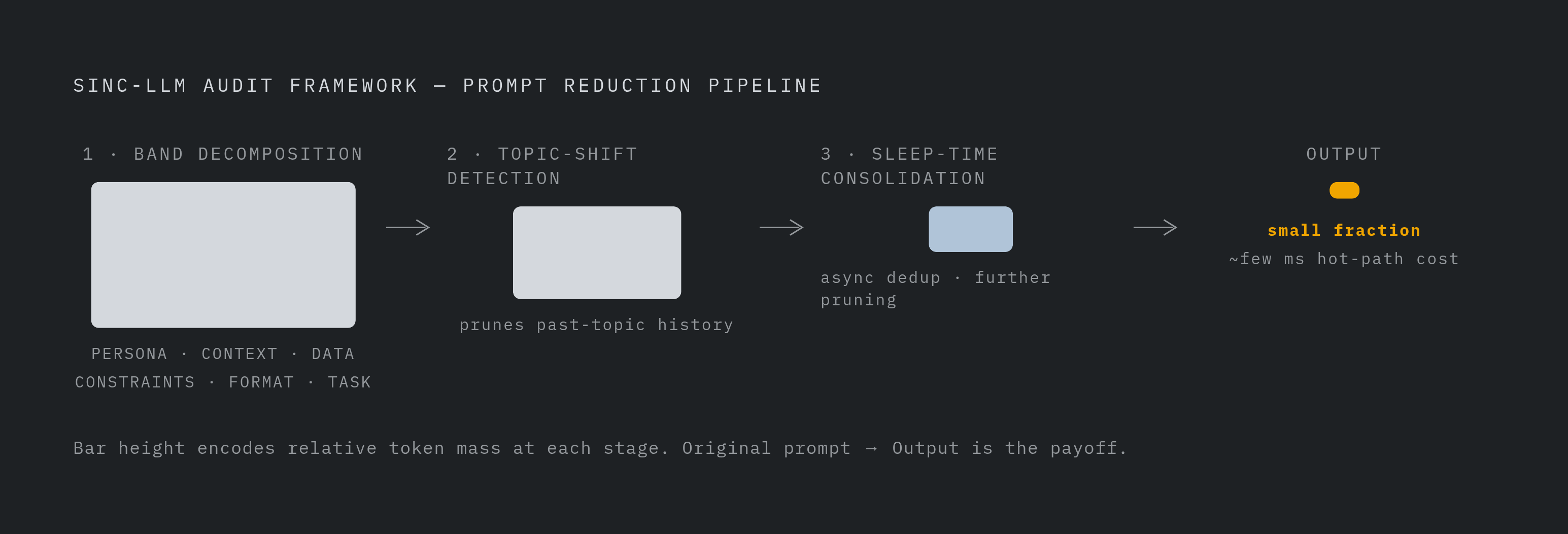
Once token data is tied to specific versions, a structured audit becomes possible, and the audit is where the recoverable cost actually sits.
The sinc-LLM framework lays out a three-stage path for finding it. Band decomposition splits a prompt into six specification bands, PERSONA, CONTEXT, DATA, CONSTRAINTS, FORMAT, and TASK, and strips out anything that doesn't belong to one of them, which cuts token count substantially on its own. Topic-shift detection prunes conversation history left over from topics the conversation has already moved past. Sleep-time consolidation runs an async dedup pass that removes messages that are semantically redundant with ones already in the prompt, and prunes prior-topic history further. Applied together, these three stages took a severely bloated, unoptimized prompt down to a small fraction of its original size, with a hot-path latency cost of only a few milliseconds.
The band decomposition step by itself tends to expose how the bloat built up: patches and worked examples appended outside any structural band, policy language repeated across multiple sections because nobody checked whether it was already there, and context that mattered for a product version that no longer exists but never got pulled out.
Version history is what turns this from a one-time cleanup into a repeatable practice. With it, a team can trace which version introduced a given block of text, see the exact token delta it added at the time, and weigh that against whatever gain in quality or completion rate it actually produced. Without version history, the same audit has to be redone from scratch every time, because there's no record of what was true before.
Prompt caching compounds the savings once the bloat is gone. Caching has been supported across Claude models going back to Claude 3 Haiku and Claude 3 Opus. At sufficient request volume, switching a workload from uncached to cached prompts on Claude saves thousands of dollars a year on system prompt repetition alone, for a typical chatbot-scale workload. Cutting the prompt down first and caching what's left are two separate savings that stack.
Where prompt versioning lives in the infrastructure stack
Prompt versioning kept only in application code or in source control ends up with gaps. Different services assemble their prompts differently, version metadata gets attached inconsistently from one team to the next, and there's no single place where anyone can check coverage or run an audit across the whole system.
The gateway sits in a different position: every LLM call passes through it, regardless of which service, team, or feature sent the request. That makes it the one place where version binding, token metering, and trace tagging can happen once, in the infrastructure layer, instead of getting rebuilt separately inside every application that calls a model.
Binding a prompt's version to the gateway route and to the trace, rather than only to a file sitting in source control, gives the production system a runtime join key: which prompt text, which version, which route, which model, which user cohort, which outcome. That's a live operational record, not a historical one.
A gateway holding the prompt registry also enforces the promotion workflow directly. A version can't reach production traffic until it clears the staging gate, so the cost and quality difference between versions gets measured before the version ships at scale, not discovered afterward in an invoice. And the gateway's real-time cost ledger closes the loop for finance and engineering leadership both: instead of reconstructing prompt token costs from an end-of-month provider invoice, version-tagged token spend is available by team, project, model, and prompt version at any point someone wants to look.
A gateway that connects a team to multiple model providers without separate keys for each one also removes a practical obstacle to acting on what an audit finds. If the audit shows that cached prompts on Claude run materially cheaper than the current deployment on another provider for a given workload, moving that workload over is a configuration change at the gateway. No new provider key, no new integration code to write, no credential rotation to coordinate. The architecture turns the finding into something a team can act on.
Building the operational practice: version gates, canary rollouts, and rollback as standard procedure
A mature versioning practice runs prompt changes through the same gates engineering teams already apply to code: an evaluation gate before anything promotes, canary traffic before a full rollout, and a rollback path ready before it's needed.
The eval gate compares specific metrics, PromptAdherence, TaskCompletion, JSONValidation, or whatever domain-specific metric applies, for the new version against the current one, on the same slice of traffic. Averaging across every version in production hides exactly the regression the gate exists to catch. Each version deploys to dev, then staging, then production in sequence, gets tested in staging before promotion, and rolls back to the last known good version the moment something breaks. That's the same discipline applied to any critical code path, not a configuration file edited wherever it happens to live.
The cost case belongs inside this same gate, not off to the side as a separate review. If a new version adds tokens without a measurable gain in quality to show for it, it shouldn't promote. A reasonable standard: production prompt changes should not raise token consumption by more than 15% without a quality result that justifies it. That makes cost overrun as legitimate a reason to block a release as a quality failure, evaluated at the same gate, by the same people, on the same data.
Canary rollout applies the same logic to live traffic. A new prompt version goes out to a small slice of real requests first, its token count and quality metrics get watched against the version it's replacing, and only once that comparison holds up does it take the rest of the traffic. Version history, trace binding, and the audit discipline built in the sections above all feed into this one moment: the point where a team decides, with actual numbers in hand, whether a new prompt version earns its place in production.