AI Spend Budgets and Alerts for Engineering Teams
Prevent runaway AI costs by catching overspend before requests are sent.
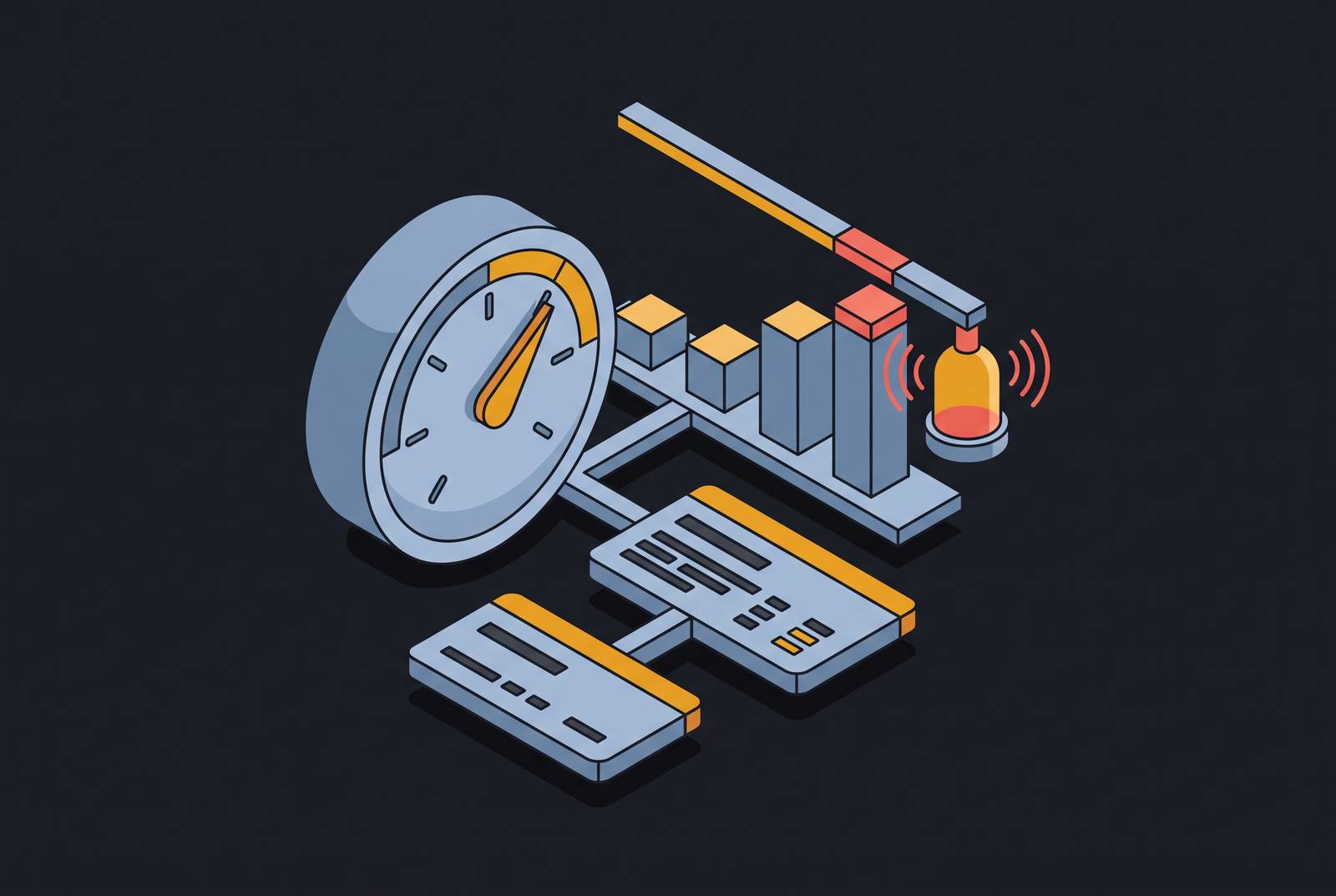
AI spend doesn't run out of control because teams are careless with tokens. It runs out because token costs scale in ways that request-counting was never built to catch, and most engineering teams have no checkpoint in place to stop a bad request before it's paid for.
Losing Control of AI Spend in Production
Request-based thinking is baked into how most engineers reason about infrastructure cost. You count the requests, estimate the load, set a rate limit, and move on. That approach breaks down completely with large language models, because two calls to the same endpoint can cost wildly different amounts depending on how many tokens go in and how many come out. A short classification prompt and a long document-summarization call might hit the same API route yet differ in cost by a large multiple.
That's why requests-per-minute limiting, the tool most engineers reach for first, does nothing to control spend. It caps how often a service gets called, not how much each call costs. Keeping spend in check requires enforcement based on tokens and dollars, not request counts.
The gap gets worse without a shared system watching every call. Each application typically holds its own provider key, writes its own retry logic, and reports usage nowhere but its own logs. Ask a reasonably sized engineering org how much it spent on LLM calls last month, broken down by feature, and nobody knows until the invoice lands. When teams run several providers across several internal tools, their cost data ends up scattered across a handful of dashboards that don't talk to each other, with no shared view of what's being spent where.
The failure mode that actually causes the damage is usually mechanical: a bug in a retry loop, an agent session that won't stop calling itself, a workflow that keeps expanding its context window with every pass. Any of these can burn through a month's budget in minutes. And the team finds out not from an alert, but from a bill.
Agentic systems make the exposure larger. A single user request can now chain a high-capability model for reasoning, a faster model for classification, a few tool calls, and a verification pass, each one consuming tokens independently. A single budget threshold watching one model can't see any of that chain. Visibility into what happened after the fact doesn't fix this. Stopping runaway spend means catching it before the call goes out. The system needs a checkpoint that sits in front of every request, not a dashboard that reports on them afterward.
The Gateway as the Place to Enforce Spend Controls
That checkpoint belongs in a gateway, because the gateway is the only part of the system that sees every request, to every provider, from every team. It sits between the application code and the model APIs, handling routing, authentication, rate limiting, and cost tracking in one place, so none of that logic has to be rebuilt inside each service.
Teams usually feel the need for this layer at a specific moment: the moment a second model, team, or provider appears. A second model, a second team, a second provider, a second question from legal about where data goes. Teams that wait past that point end up re-implementing routing, budgets, and cost tracking separately in every service, then bolting a gateway on later, usually under the pressure of an incident that already happened.
Timing is what actually matters for spend control. A provider's billing dashboard tells a team what it spent after the money is gone. A gateway sitting in front of every call can check a budget before the request is sent, and block or reroute it if the team is out of room. That's the difference between finding out about an overspend and preventing one.
Centralizing provider keys in the gateway changes the security picture too. When every service holds its own raw key, if a single credential leaks, an attacker gets direct, unthrottled access to the provider's quota. When keys live only in the gateway's vault and applications carry scoped, short-lived tokens instead, a leaked token is already rate-limited, already budget-capped, and can be revoked instantly.
The gateway also produces something no provider invoice does: a metering event for every request; a usage record showing tokens in, tokens out, model, and cost at the moment the call happens. That record becomes the real source of truth for spend, replacing invoices that for some Enterprise billing cycles don't show up until weeks after the usage occurred. With tokens, model, route, latency, cost, and team attribution logged per request, a spike that used to take a day of digging through logs turns into a five-minute dashboard query.
How to structure budgets by team, project, and model
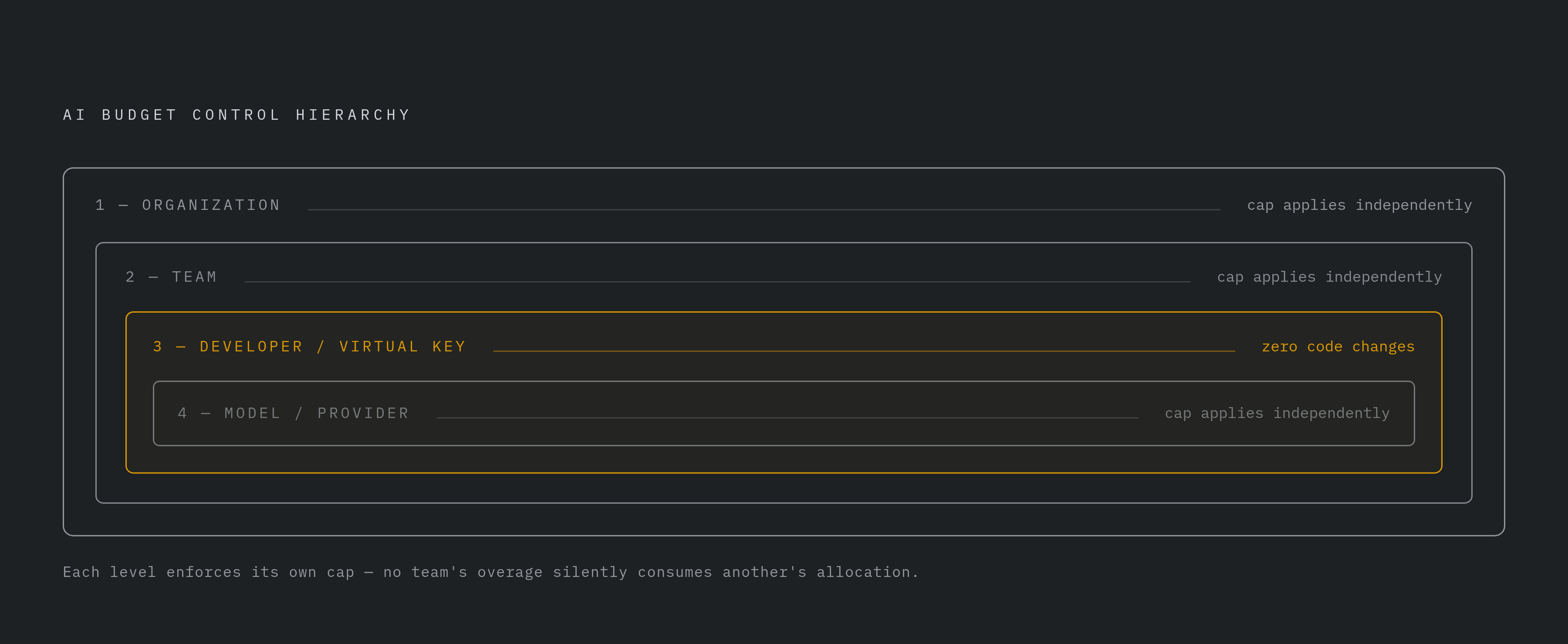
Once the gateway is the control point, spend needs to be organized the way an organization actually works, not as one giant shared number. A working budget hierarchy has four levels: per-organization or customer, per-team, per-developer or virtual key, and per-model or provider. Each level gets enforced on its own, so one team running over its allocation doesn't quietly eat into another team's budget for the month.
Virtual keys are what make the team and developer levels enforceable without touching a single line of application code. Each team, application, or individual developer gets a scoped gateway token tied to its own allocation. The gateway tracks and caps spend against that token directly, with no need for the provider's raw credentials to ever leave the gateway's vault.
Monthly or weekly caps aren't granular enough on their own for agentic workloads. A single agent run can trigger hundreds of model calls before a monthly rollup even notices the spend happening. Per-run caps catch the one runaway workflow before it burns through an entire month's allocation in an afternoon, backstopping the team-level budget.
This kind of hierarchical control, set at the organization, team, and application level with automatic enforcement, is now a baseline requirement for running AI in production, not a feature reserved for enterprise contracts.
Model-level budgets solve a different problem than team-level budgets. They let engineering leaders manage the mix of models being used across the whole portfolio, so a high-capability, higher-cost model doesn't quietly absorb spend that was planned for a cheaper model handling simpler tasks.
A split between a control plane and a data plane produces these visible facts. The control plane holds the budget state: the counters and the policies. The gateway itself reads that state on a short refresh interval and enforces it on every request. Because the control plane never sits directly in the request path, enforcement adds almost no latency to the call. Budget design also has to account for how usage gets counted: real-time counters in fast storage handle the moment-to-moment enforcement, while durable aggregate tables handle reporting after the fact. Both need to stay in sync, so a team's spend never slips past its cap just because a rollup job ran a few minutes late.
Designing alerts that fire before spend becomes a problem
Budgets set the ceiling. Alerts decide whether anyone finds out before that ceiling gets hit. A single notification that fires right at the budget limit isn't an alert system, it's a record of what already happened.
A graduated structure works better: notifications at roughly 50%, 75%, and 90% of budget. Each threshold gives a team a different kind of decision to make. At 50%, it's a nudge to keep an eye on pace. At 75%, it's a prompt to actually look at what's consuming tokens. At 90%, it's time to escalate to a real conversation about the budget itself, before anything gets cut off.
These alerts should come from the same place the spend data comes from. The budget counters in fast storage and the policies in the control plane are what produce threshold alerts per team and per model, and the same stream of metering events that feeds the spend dashboard is what triggers the alert. There's no separate reporting pipeline to keep in sync, because there's only one source of truth.
Agentic workloads need a second kind of alert that watches a different signal entirely: anomaly detection on cost per run, not just cumulative spend against a rolling budget. A single runaway agent session can exhaust a week's budget faster than a threshold alert on the overall counter would ever catch it.
What happens after an alert fires determines how much damage the spend event causes. If spend crosses a threshold, routing automatically to a cheaper model is a very different response than simply blocking requests. Auto-switching keeps the workflow alive, slows the rate of spend, and buys time for a human to make a real decision, instead of turning a budget issue into a support incident on top of a finance one.
Choosing the right enforcement action for each threshold
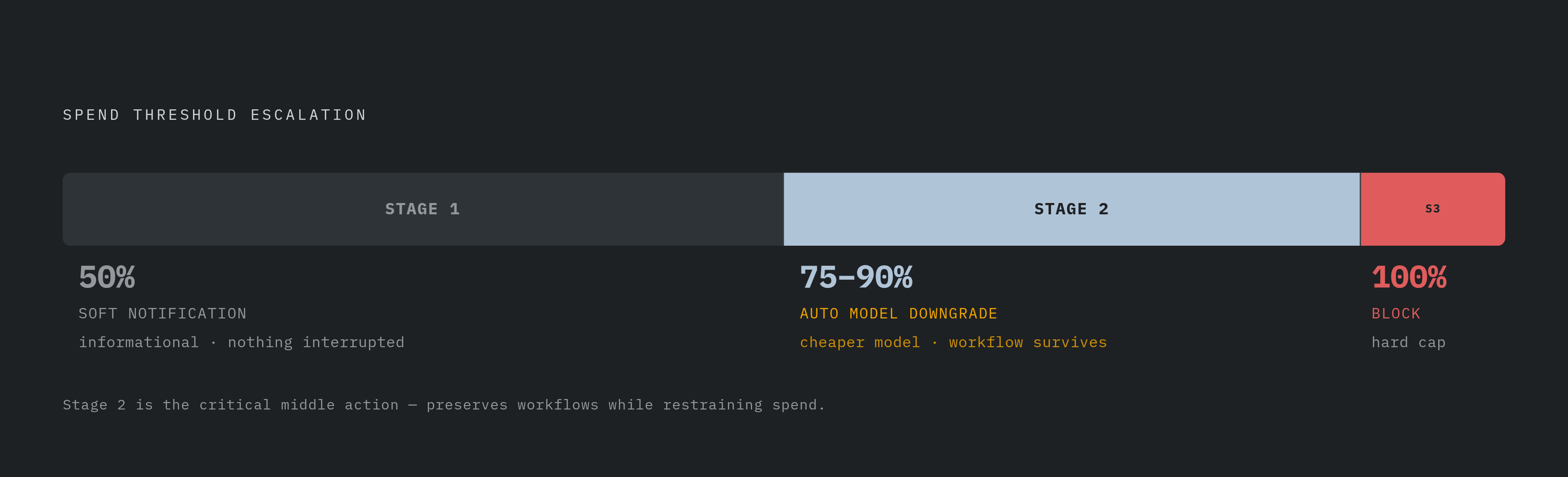
Every threshold needs an action that matches how urgent the situation actually is. Soft alerts fit the early thresholds, because they preserve a developer's ability to keep working while flagging that spend is tracking ahead of plan. Automatic model downgrade fits the higher thresholds, because it keeps a workflow running while cutting the cost rate. Hard caps belong at the ceiling, because at that point the priority shifts to protecting the organization from a runaway process. Mixing these up in either direction produces a system that's either background noise nobody acts on, or one that breaks workflows that didn't need to be stopped.
The early thresholds should stay purely informational. A team crossing 50% or 75% of its budget needs to know its consumption is running ahead of plan, and needs time to look at which workflows are actually driving the cost. Nothing in flight should be interrupted at this stage.
The higher threshold is where automatic downgrade earns its place, routing requests to a cheaper model in the same family. This matters most for agentic workloads specifically, where stopping a multi-step session in the middle doesn't just save money, it breaks whatever the agent was doing and turns a cost problem into a support ticket.
Hard caps still matter, but they work best set above the automatic-downgrade threshold. A hard cap exists to stop a runaway process or a misconfigured agent from doing real damage. It isn't meant to be the primary lever for managing day-to-day cost.
None of this works if the thresholds live in application code. Enforcement policy needs to be configuration that the gateway reads from the control plane on a short refresh cycle. A budget change, a new threshold, or an emergency cap should take effect across every service within seconds, with no deploy required to make it happen.
Measuring cost per task rather than cost per token
Spend control only matters if the organization is measuring the right thing once it's in place. Cost per token sounds like a precise metric, but as a primary measure it rewards using AI less often, which runs directly against the reason the organization adopted it. The number that actually matters operationally is cost per task, per workflow, or per resolved unit of work, measured against what that same unit of work cost before AI was involved.
Getting to that number depends entirely on the observability the gateway already produces. Tokens in, tokens out, model, route, latency, cost, and attribution to a specific team and feature are what turn a raw spend total into something that can be compared against outcomes. Without that trace-level attribution, cost is just a total sitting on an invoice, disconnected from what it bought.
Attributing cost to a specific feature or workflow lets engineering leaders ask a sharper question than "how much are we spending": is this particular AI feature cheaper than what it replaced? That question is what decides whether a workflow gets scaled up, optimized, or cut.
Caching plays directly into this number. Semantic caching at the gateway level returns stored responses for prompts that are similar in meaning, not just identical in text, which cuts the token cost per task meaningfully for FAQ-style or repetitive workloads, without any loss in output quality.
Routing decisions deserve the same lens. A cheaper model that needs more retries, longer prompts, or manual correction downstream can end up costing more per completed task than a pricier model that gets the job done in a single call. A model's per-token price alone fails to capture that.
Reframing cost this way also changes the conversation with finance. If a line item shows raw token spend with no context, it invites optimization for the wrong thing, usually just spending less. But if a number shows cost per resolved support ticket, or cost per completed code review, finance has something it can actually weigh against business value.
What a managed gateway provides that a self-built system does not
Everything described so far, the budget hierarchy, the graduated alerts, the tiered enforcement, the cost-per-task tracking, has to be built and maintained by somebody. The build-versus-buy decision on that work has shifted. By 2026, building a gateway from scratch is justified only under specific conditions: extreme latency requirements, data-sovereignty rules that block any third-party hop entirely, or proprietary routing logic that doesn't fit standard frameworks. Outside those cases, adopting an existing gateway serves a team better than building one.
A self-built gateway carries a cost that is invisible in the first architecture diagram. Keeping it running means maintaining a model registry, syncing provider pricing as it changes, handling model deprecations, running the metering pipeline, and keeping enforcement policies current. That's ongoing engineering time spent on infrastructure.
For teams where AI usage is growing faster than internal governance can keep pace with, a managed gateway with spend controls, role-based access control, and audit logging already built in provides that governance immediately, without requiring a dedicated platform engineering team to stand it up first.
The provider abstraction a managed gateway offers also changes how routing decisions get made day to day. If a budget threshold triggers a cost-optimizing model switch, that becomes a routing rule change, not a code deploy. That difference, changing a rule instead of shipping new code, is what separates a spend control system that teams actually use from one they quietly route around.