Real-Time AI Spend Dashboards That Break Down Cost by Team, Project, Model, and Provider
Track AI spend by team, project, model, and provider to surface where costs actually come from.

A monthly AI invoice arrives, the number is bigger than last month's, and nobody in the room can say why. That's the core failure of tracking total token spend: it tells an organization what it paid without telling it which team, feature, workflow, or model choice produced the bill. Agentic workflows make the gap worse: a single agent task runs up costs across every model call, tool call, and retrieval step in the chain, and those costs tend to get grouped by model or service type rather than by the task that actually generated them, even when they appear as separate line items on a provider invoice.
The gap widens as adoption spreads. The pattern that follows is familiar in finance and engineering organizations alike: finance escalates an unexpected AI bill, engineering has no data to explain it, and what should be a fix becomes guesswork. That cycle repeats every billing cycle until attribution gets solved structurally, at the level of the system that generates the spend in the first place, not at the level of the report that summarizes it afterward.
The four dimensions that make a spend dashboard genuinely actionable
A real-time AI spend dashboard becomes a cost-control tool only when it breaks spend down by team, project, model, and provider at the same time. Each of those four dimensions exposes a different category of waste, and no single dimension can surface all four. Team attribution shows who is spending. Project attribution shows what the spending is for, tying cost to a specific feature, use case, or customer workflow so ROI can be measured at the level of the actual unit economics. Model attribution shows what capability is actually being bought, revealing whether a workflow is burning frontier-model pricing on a task a cheaper model could handle just as well. Provider attribution shows where the money is going structurally, and it spans commitments, redundant vendor relationships, and consolidation opportunities.
These four views interact constantly. Leaving out any one of the four dimensions stops the diagnosis partway: a team sees that costs rose, suspects a cause, but can't confirm it or act on it. The next four sections take each dimension in turn.
Team-Level Attribution and Budget Enforcement
Team-level attribution only delivers real cost control when budget enforcement happens inline, before the provider call goes out, rather than as a report generated after the money has already been spent. A team that has used up its monthly allocation needs to be rejected at the gateway before that call reaches the provider. A system that meters spend but never blocks it is a reporting tool. Calling it a control tool overstates what it does.
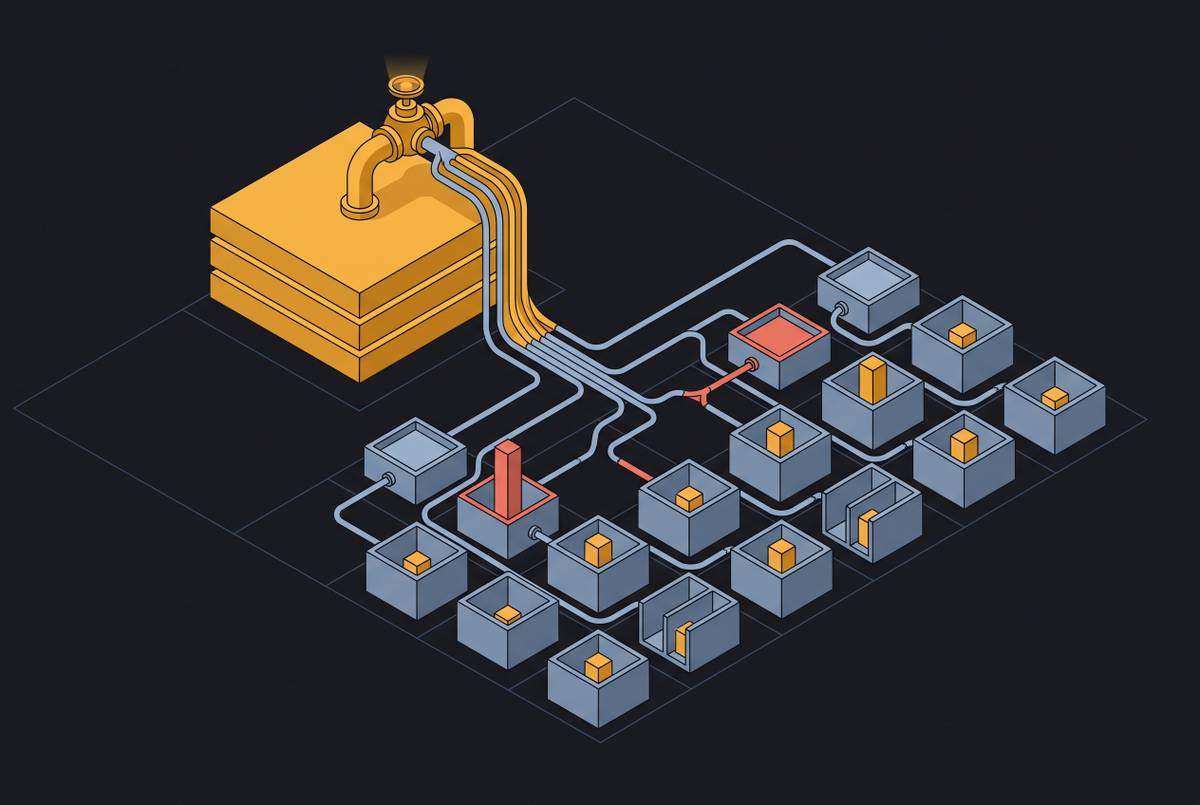
The practical architecture behind this is straightforward: budgets exist as counters in a fast data store, policies get enforced at the routing layer, and alerts fire at a threshold below the hard limit, so teams can adjust before they hit the ceiling. Virtual keys make the attribution automatic. The exposure is bounded by design, not by discipline.
That distinction, between design and discipline, is what separates a structural control from a hopeful one. When provider keys sit scattered across application code and teams self-report their own usage, attribution only works if everyone remembers to do it right. When keys live only in the gateway and the gateway enforces budgets inline, attribution and control stop depending on anyone's memory. Platforms that route requests across multiple providers, Concentrate's unified API among them, can enforce this kind of spend attribution at the routing layer itself, which makes team, project, model, and provider tracking structural rather than something bolted onto application code after the fact.
What project-level attribution reveals about the unit economics of individual workflows
Project-level attribution turns a spending figure into a business decision. "This feature costs X per user interaction" is a fundamentally different fact than "this team spent X this month," and only the first one supports a real tradeoff. Without project tagging, a team's entire budget could be dominated by one feature nobody has ever evaluated for efficiency, and the team's aggregate spend number gives no hint that this is happening.
Agentic workflows raise the stakes on this further. Because a single agent task generates costs across multiple model calls, tool calls, and retrieval steps, the cost per workflow completion, not the cost per API call, is the number that actually reflects what the feature costs to run. Project-level attribution does. It shows which workflows are efficient and which ones are candidates for optimization or outright deprecation.
Model-Level Attribution and Routing Decisions
Model-level attribution makes visible what may be the single largest lever in AI cost management: whether a workflow is running on the model whose cost-per-successful-output actually fits the task, instead of the model a team happened to default to first. The pricing spread across models is wide enough that a routing decision carries the same financial weight as an architectural one. The same volume of tasks can produce dramatically different monthly costs depending entirely on which model handles them.
The metric that matters here is cost-per-success, not cost-per-call. Benchmark comparisons across models at different price points and success rates make the point concrete: choosing between them is a quality-threshold decision, not a simple price comparison, and making it correctly requires per-model cost and quality data pulled from actual production traffic, not a vendor's price sheet.
Consider a team routing a complex extraction pipeline to a cheaper model because the price table looks favorable on paper. Model attribution also catches a failure mode that's easy to miss otherwise: when a provider silently changes the model sitting behind an API alias, per-model cost and quality metrics shift in ways that an aggregate spend figure simply can't register.
Provider-Level Attribution, Consolidation, and Commitment Risk
Provider-level attribution makes visible a class of problem that model-level data can't touch: underutilized commitments, redundant provider relationships, and the risk of concentrating spend on one provider without anyone tracking how much concentration has built up. Organizations tend to accumulate provider relationships incrementally. One team adopts OpenAI, another standardizes on Anthropic, a third brings in Google, and without provider-level rollups, nobody can see the total spend per provider or confirm whether negotiated volume commitments are actually being honored.
Provider-level data also feeds directly into failover planning. If the majority of production traffic runs through a single provider, you have a concentration risk, and you should address it before an outage forces the issue, not after. Finance teams need this same data to manage commitments: a negotiated volume discount creates an obligation to route enough traffic to justify it, and tracking that obligation requires provider-level spend visibility close to real time, not a quarterly reconciliation.
Provider and model attribution together let routing strategy operate at the right level of abstraction. The goal was never to use one specific model forever. You want to hit cost, speed, and quality targets, and the optimal route to those targets shifts as providers update pricing or release new model capabilities. The data layer has to exist before any of that optimization becomes possible.
Unifying the Four Dimensions in a Single Real-Time View
Multi-dimensional attribution loses its value if the data only becomes available at the end of a billing cycle. If granularity is real-time, a cost anomaly gets caught and diagnosed within hours of happening, not discovered three weeks later in an invoice review. A cost regression deserves the same treatment a performance regression gets: caught automatically, with enough context attached to localize the cause without a manual investigation, and that requires all four dimensions, team, project, model, and provider, present on the same event record, not scattered across four separate reports that someone has to cross-reference by hand.
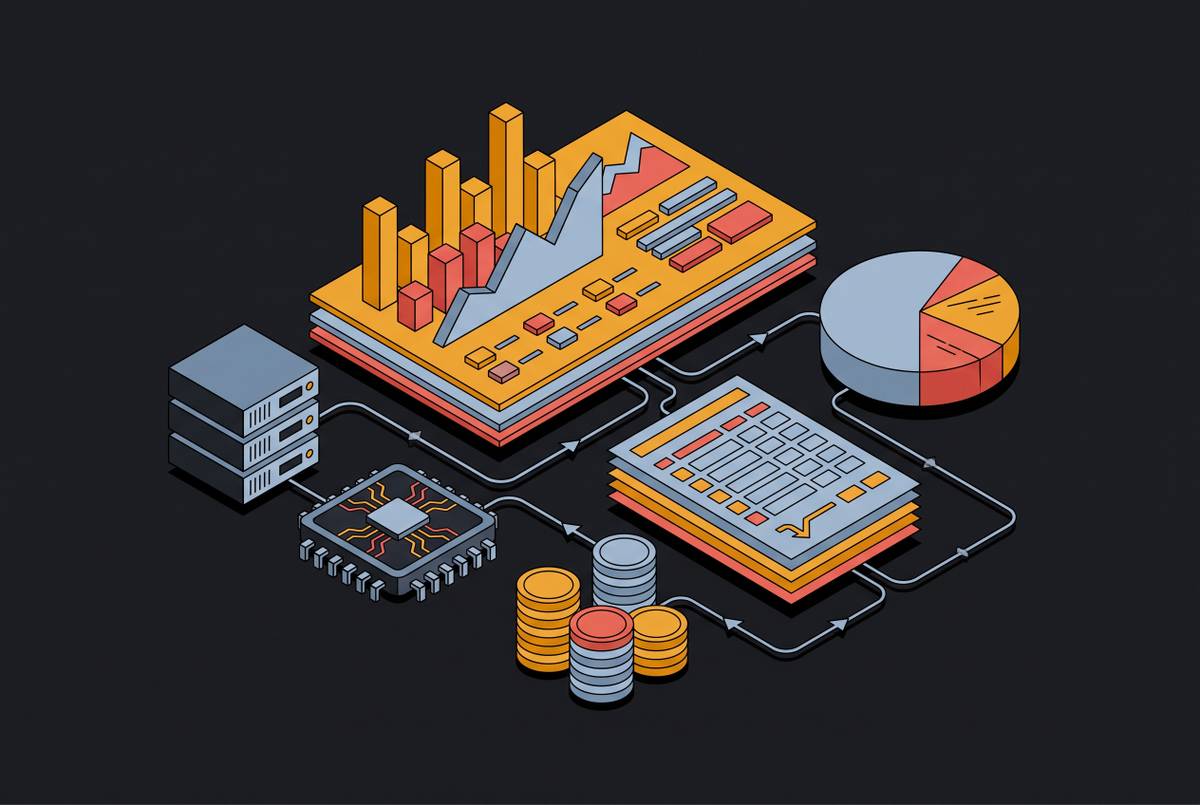
The data architecture that supports this is fairly specific. Every request produces a structured usage event carrying tokens in, tokens out, cost, model, provider, team, project, and user. Those events flow into a durable pipeline, and rollups aggregate them into per-dimension tables that feed dashboard queries and alert rules. Alert logic depends on cross-dimensional thresholds to be useful. An alert that fires when team-level spend crosses a fraction of monthly budget is helpful. An alert that fires when a specific project's cost-per-call doubles within a rolling window is diagnostic, and that second kind of alert only works if all four dimensions sit on the same event record together.
Ramp launched AI Token Spend Management in April 2026 and gave it a broader public announcement on July 16, 2026, and it shows concretely what this kind of visibility makes possible. According to Ramp's launch materials, a controller at AngelList, Greg C., found the system had surfaced a missed prompt-caching optimization: "we found we'd been losing $10,000 a month," and engineering implemented the fix the same day. That's the loop real-time, cross-dimensional visibility is supposed to produce: observation leads to diagnosis leads to a same-day fix, instead of a line item nobody can explain until the next invoice.
Different stakeholders need different cuts of this same underlying data. All three views depend on the same four-dimensional event stream at the source. Building that stream once lets all three audiences draw from it.
Why the gateway layer is the only place this data can be collected reliably
Attribution data at this level of detail can't come from post-hoc reporting or from provider invoices. It requires a control plane sitting directly in the request path, metering every call the moment it happens. Multi-dimensional spend attribution only holds up when it's collected at a single point every request passes through, because any approach that relies on individual teams tagging their own calls, or on reconciling several provider dashboards by hand, produces gaps and delays that undercut the value of the data before anyone gets to use it.
Provider invoices aggregate across all traffic tied to an account. They carry no team or project tags, they report costs only after the billing period has already closed, and they reflect a single provider's view of the world. None of the four dimensions can be reconstructed from an invoice after the fact, because the invoice was built to carry billing totals, not that information. Application-level instrumentation, where each service or team adds its own logging, runs into a different limit: its coverage is only as good as the discipline of every engineering team involved, and gaps in that coverage stay invisible until a cost anomaly exposes them.
A gateway sitting in the request path meters every call with team and project attribution at the moment the call happens, regardless of which application or engineer made it. Completeness is a property of the architecture, not a hope about everyone's habits. That same position in the request path is what makes inline budget enforcement possible, not just after-the-fact reporting, along with provider key centralization and semantic caching that cuts costs that would otherwise show up as real spend in the attribution data. A reporting tool sitting outside the request path can't offer any of that. If a gateway issues scoped virtual keys to each team and enforces budget limits before a provider call goes out, it can bound the financial and security exposure of a leaked credential automatically, and no one needs to rotate provider keys or coordinate across applications.
There's a simple trigger for when this architecture stops being optional: the second of anything. The second model, the second team, the second provider, the second compliance requirement. That's the point where fragmented attribution turns into a structural problem, and a gateway is what resolves it.
What to look for in Concentrate and other tools that provide this kind of spend visibility
To evaluate a spend-visibility tool, check whether it actually delivers the four-dimensional, real-time attribution the rest of this argument depends on, not whether its dashboard looks complete at a glance. A few specific capabilities separate a genuine control plane from a reporting layer with a nicer interface.
Look for inline budget enforcement, not just metering after the call has already gone out. A tool should reject a request at the point a team's allocation runs out, the way Concentrate's spend limits and access controls operate at the key level, rather than surface the overage in a report the next morning. Look for virtual keys that map cleanly to teams or services, so attribution happens automatically instead of depending on every engineer remembering to tag a request. Concentrate issues API keys per workspace and team, and it attaches spend limits and role-based access controls directly to those keys.
Look for per-model and per-provider cost and quality data pulled from actual production traffic, not list pricing. If a gateway routes across hundreds of models and dozens of providers, the way Concentrate does through a single API, it should show you real cost-per-call and cost-per-success figures for each one, not just a static comparison chart. Look for fallback routing built into the architecture, so a provider outage or rate limit can't take a workflow down. Concentrate lets a team set a chain of providers for a given model, with automatic fallback when one is unavailable.
Look for compliance and governance baked into the gateway rather than added later: SOC 2 Type II, zero data retention, SSO, role-based access controls, and audit logs are the baseline a serious engineering or finance team should expect from a control plane handling this much spend and this much sensitive routing data. And look for pricing that doesn't tax the attribution itself: a tool that charges a markup on every token routed through it is adding a cost to the very visibility it's supposed to provide, while a pass-through model, buying tokens at provider rates with no added service or credit card fees, keeps the incentive aligned between the vendor and the team trying to control costs. Those are the specific, checkable criteria that separate a dashboard from a control system, and the latter is the one actually worth building around.