Metadata Tagging Strategies for LLM Cost Attribution Across Projects and Teams
Consistent metadata at the gateway enables real-time cost attribution across teams and projects.
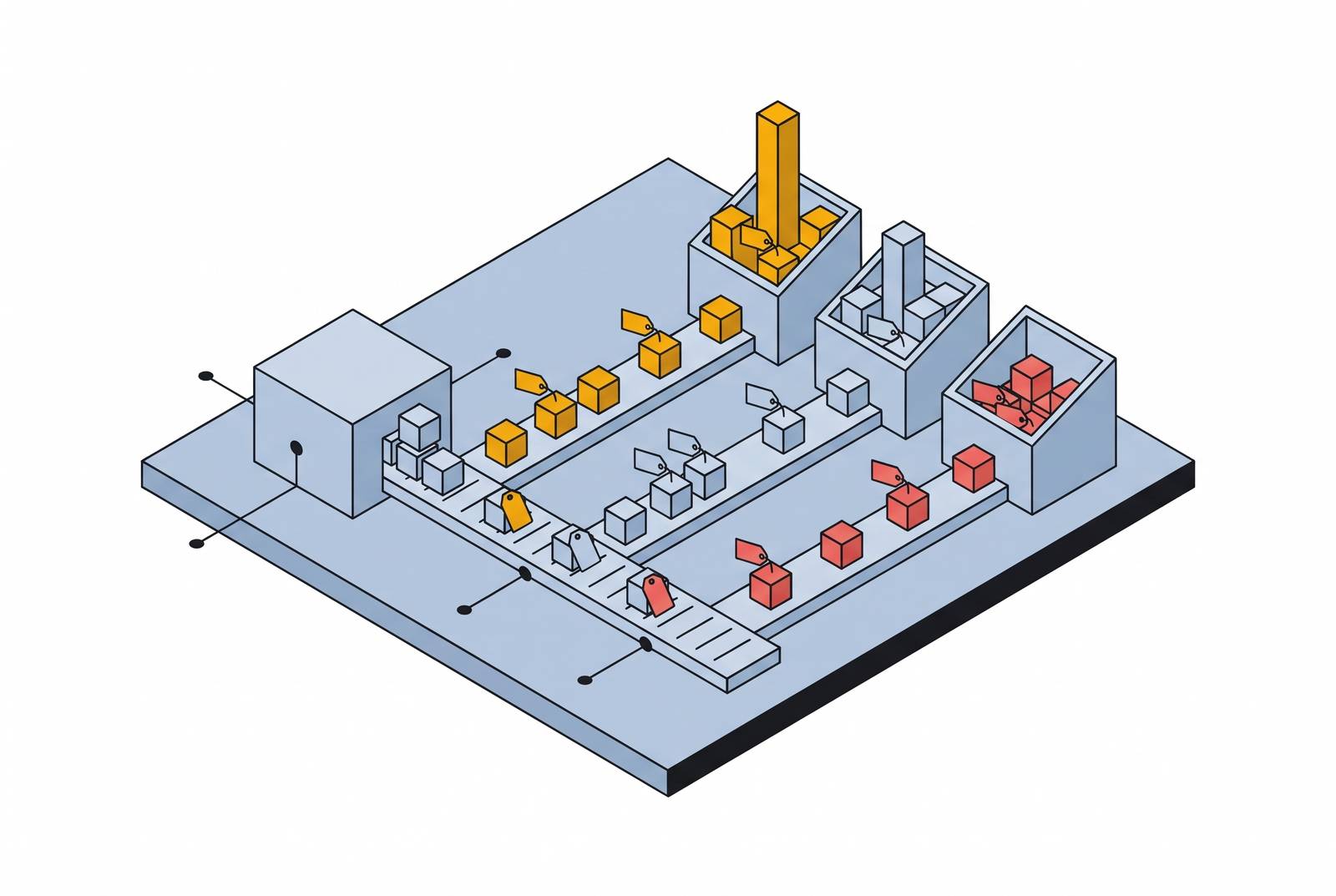
LLM cost visibility and AI spend tracking by team and project start with a consistent metadata schema enforced at the gateway. Every request needs ownership tags, an end-to-end trace identifier, and usage details to work out its cost across models and providers. Tagged traces then support real-time spend views, chargeback reporting, and budget controls without making provider credentials stand in for organizational ownership.
Why provider invoices cannot answer the questions engineering and finance actually ask
A VP of Platform preparing for a Q2 budget meeting needs to explain which teams generated the spend. Anthropic exposes usage by API key, workspace, and model, while OpenAI supports project and API-key breakdowns. Those views identify billing boundaries, but they do not establish which application, feature, or customer caused each charge.
Assigning one credential per team restores coarse attribution, but constrains cross-provider fallback, model selection, and regional load balancing. Application instrumentation has a different weakness. Across SDK versions and new microservices, ownership logic can drift or disappear, while asynchronous hops can lose the original context. Billing and trace records can also land in separate systems without a stable join key.
These gaps conceal distinct causes of overspend. Braintrust's 2026 cost-tracking playbook points to runaway agent loops, retry storms whose tokens never reach application success logs, and prompts that grow and raise the cost of each feature. An invoice collapses those differences into billed usage. The structural cause is that the credential boundary and the team boundary are different things, and provider-side dashboard work cannot close that gap.
Why the gateway is the only chokepoint where attribution can be enforced consistently
When every provider call routes through a gateway, ownership can be attached before provider selection. The request retains its attribution when fallback sends it somewhere other than the application expected. Application-only instrumentation cannot enforce the same rules across all services when each is maintained on its own. By the time provider-side reporting starts, it is too late to recover missing ownership.
Post-hoc parsing therefore solves the wrong problem. An opaque model call with provider, model, and token count cannot show which feature used it if that context was already lost upstream. An end-to-end trace paired with an ownership contract preserves the evidence needed to explain why Support Automation generated spend through a credential belonging to Platform.
Agentic workloads amplify the need for that contract. One run can generate repeated tool calls, retries, and long execution chains, so ownership must persist across the individual spans. Infrastructure-level visibility distinguishes normal demand from a runaway loop without relying on every application to implement attribution identically.
The minimum viable tagging schema and why each field earns its place
The schema begins with who owns the request. team_id or cost_center supplies the department accounting and chargeback dimension, while project_id and feature connect spend to delivery work and product surfaces such as “chat”, “summarization”, and “agent_research”. user_id supports individual quotas and abuse detection. For multi-tenant B2B SaaS, customer_id names the organization as a whole. Both user and customer identifiers should be hashes or opaque, non-PII handles.
Workflow fields explain what happened within that ownership boundary. agent_run_id groups a multi-step execution, while prompt_version pins the template hash needed to investigate regressions. environment separates production from staging and development. The request_id or trace_id is the end-to-end join key across gateway, router, workers, and provider logs.
The cost record also has provider, model, and service_tier for pricing and cross-provider normalization, along with cache_hit and cache_policy to show which calls were discounted or bypassed. TrueFoundry uses X-TFY-METADATA for a per-request JSON object stored on the trace, with a curated subset projected into metric labels. OpenTelemetry baggage belongs in the request-context propagation design, while Braintrust's logger.traced attaches metadata at span creation.
At span close, token usage is priced against a versioned table, including input, output, and reasoning tokens where applicable. Cache reads, cache writes, audio minutes, and image inputs each need their own price lines.
Cardinality discipline and the boundary between metrics and traces
Not every tag belongs in a metric label. Low-cardinality dimensions, including team, app or feature, environment, model, provider, and a controlled set of prompt versions, support separate chart and alert series. High-cardinality identifiers such as user_id, agent_run_id, customer_id, and request_id stay on traces for filtering and investigation. Turning each identifier into an independent series causes aggregation explosion.
The two tiers serve different operational needs. Braintrust recommends alerting across feature, deployment, and model, then drilling into users or agent runs when an alert fires. TrueFoundry describes streaming pre-aggregation from traces into minute counters, hourly rollups, and daily team × app × model rows, using ClickHouse or TimescaleDB. Without that discipline, dashboards become either too coarse to act on or too noisy to read.
How can teams track AI costs by team, project, and model in real time?
Daily team × app × model rows give finance a chargeback view joined through team_id, and project tags tie that spend to the budgets for delivery work. This is the output for the Q2 budget meeting. Product and engineering read feature × model × environment to see how much it costs to serve each request, then use prompt_version to look into changes. Grouping by agent_run_id separates one expensive execution from a general increase in traffic.
Normalized costs let teams compare premium reasoning and budget models for the same feature rather than treat the configured provider key as a permanent model choice. TrueFoundry supports scheduled or on-demand chargeback exports from this attribution pipeline.
Amazon Bedrock illustrates the alternative assembly work. Metadata added to each request in invocation logs does not become a native allocation tag in Cost Explorer or the Cost and Usage Report. AWS also supports native allocation through IAM principal attribution, application inference profiles, Projects, and Workspaces, which flow into Cost Explorer and CUR 2.0. For attribution based on invocation metadata, teams join logs with billing data at model and usage-type grain and calculate costs from token counts and a separate pricing table. That reconstruction can produce answers days after the spend.
Budget enforcement at the gateway and the concurrency problem
Visibility becomes control when the gateway checks budgets before forwarding requests. Hierarchical enforcement can evaluate organization, team, project, and virtual-key scopes, rejecting a call when an applicable hard limit is reached. Soft limits serve a different purpose. Alerts preserve availability while flagging anomalies, whereas rejection protects against runaway usage and quota exhaustion. Daily, weekly, and monthly resets keep these controls in step with the periods finance reports on.
Concurrency complicates an apparently simple budget check. Two requests can both pass before either posts its cost, leaving a naive “check budget, then spend” sequence open to a race condition. TrueFoundry addresses that race with an atomic Redis counter. Virtual keys complement budget accounting by delegating spend authority through scoped credentials with budgets, rate limits, and model allowlists.
Available gateways differ in their control surfaces. Bifrost rejects requests that would go over budgets set at virtual-key, team, customer, or provider-configuration level. LiteLLM tracks spend across keys, users, teams, organizations, end-users, tags, and models, and propagates a virtual key's tags onto its requests. Concentrate AI provides managed real-time tracking by team, project, key, model, and provider without markup or a platform fee. That gives teams spend visibility without operating a proxy, but visibility should not be confused with a guarantee of hard-cap enforcement.
PII and PHI in tagged metadata and enforcement before storage
Ownership identifiers create a data-handling obligation of their own. Metadata and accompanying prompts must be screened for PII and PHI before reaching the trace store or a model provider. Raw identifiers do not belong in attribution records. Per-application redaction can drift across services, while gateway enforcement applies one policy before requests reach different models and creates a centralized audit trail.
Records need who, what, when, which model, and which data category, but logging a redacted value creates another copy of the protected data. SSO, RBAC, and immutable audit logs exportable to a SIEM complement redaction by controlling access and supporting review.
Concentrate AI has a HIPAA-compliant gateway for teams in healthcare and other regulated fields that handle PHI. Its controls include gateway-layer PII and PHI redaction and zero data retention enforced at the routing layer, with a BAA available on the paid plan. That retention control does not make a claim about the policies of every provider.
Operational choices between a managed gateway and a self-hosted proxy
Self-hosted gateways offer control over deployment topology and data residency, but make the team responsible for the proxy, dependencies, patching, and on-call response. LiteLLM requires PostgreSQL, with Redis additionally required for multi-instance deployments. Bifrost is another self-hosted option. The attribution schema can stay the same with either approach, though the work of running it differs.
Supply-chain response is part of that burden. In March 2026, a poisoned Trivy GitHub Action stole LiteLLM's PYPI_PUBLISH token and enabled malicious packages to be uploaded to PyPI. The affected versions were quickly quarantined, and maintainers shipped a CI/CD pipeline that was hardened and isolated. The incident shows a dependency risk operators must watch for while keeping self-hosting as an option.
Observability and enforcement also have distinct roles. Langfuse provides hierarchical traces, per-generation token and cost tracking, dashboards, and automated spend alerts, but is not an enforcement gateway. Larger organizations may add a FinOps layer for chargeback, cross-source attribution, and forecasting. At smaller volumes, a gateway and observability stack can cover attribution without that additional layer.
Concentrate AI offers a fully managed alternative with no proxy to maintain and no markup, platform fee, card fee, or BYOK fee. Its controls include redaction, zero data retention, SSO, RBAC, and audit logs, with a BAA available on the paid plan. Automatic fallback adds an operational capability with a governance consequence. When a provider switch retains the same ownership tags and records the fallback event, failover costs remain in the originating team's and project's rollups.
A practical implementation sequence for teams starting from zero attribution today
A phased rollout can unlock useful reporting before the entire schema is deployed. In the first phase, calls go through one gateway with team_id, project_id, and environment attached, so teams can start to see their costs without changing application business logic. The next phase adds feature, prompt_version, and agent_run_id, exposing serving costs and isolating expensive agent executions.
The third phase makes that visibility sustainable. Low-cardinality fields become metric labels, while user, customer, and agent-run identifiers stay on traces for drill-down. Daily rollups and a chargeback export schedule then align the output with finance reporting periods.
The fourth phase adds budget controls progressively. Soft alerts on team thresholds provide an initial warning layer before hard rejection is introduced, while atomic accounting addresses concurrent requests and reset cycles match reporting periods. For regulated teams, redaction belongs earlier, before the first phase completes and before metadata or prompts reach storage or providers. Concentrate AI's gateway provides a managed option for that requirement, with a BAA available on the paid plan.
The completion test is a chargeback question. The trace store should explain why a team owned its share of yesterday's spend on a model, without consulting the provider console or reconstructing context from application logs.