Why Your LLM Invoice Arrives as a Black Box and How to Reconstruct Ownership Before It Lands
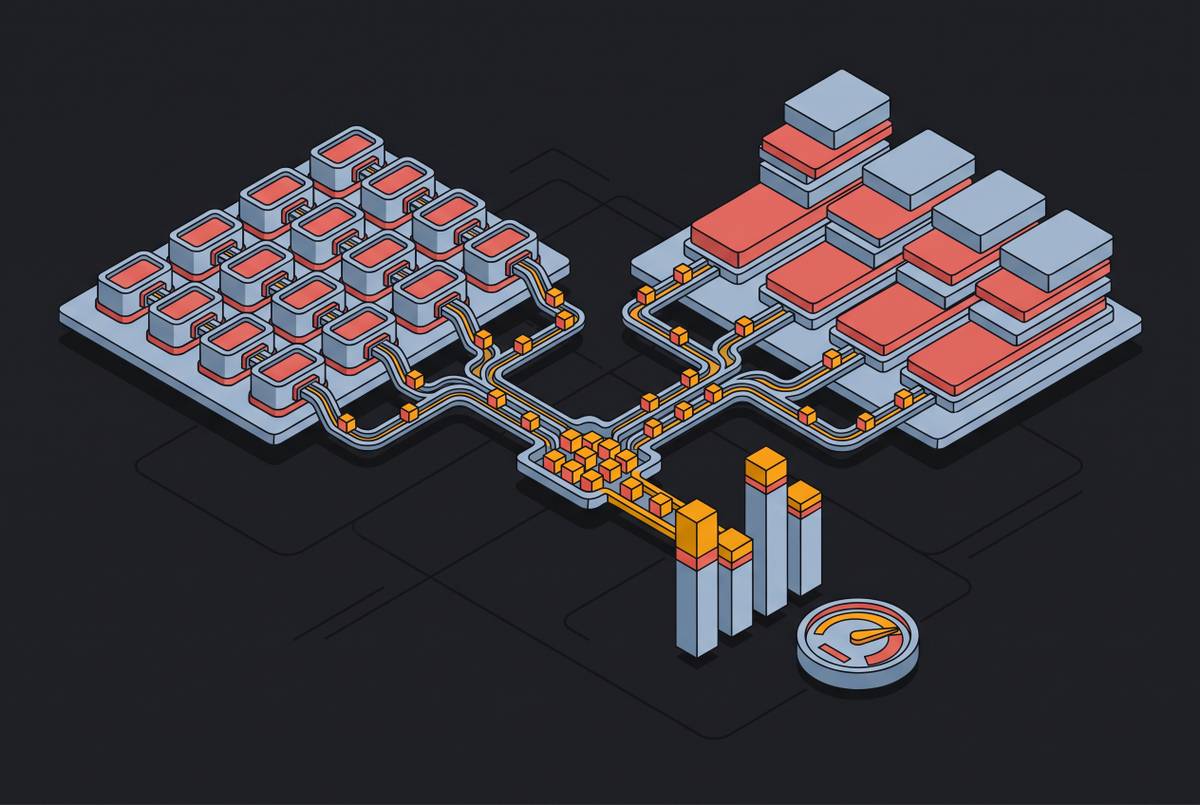
A gateway layer attributes each LLM request to its owner before billing.

Real-time AI spend tracking by team, project, model, and provider requires a shared gateway that attributes each request to its owner before forwarding it. Direct-to-provider integrations scatter that context across keys and dashboards, leaving invoices unable to explain organizational ownership. The remedy is request-level attribution and budget control before billing.
Why LLM invoices arrive as unattributable lump sums
The invoice arrives, and no one in the room can explain which projects generated the total. Engineering can identify the provider account, but finance needs an allocation by team or cost center. Those are different units of accountability. The provider bills for tokens consumed against a key.
The underlying integration usually began as a reasonable shortcut. One engineer with one project needed one key, one provider, and one dashboard. As teams multiplied, they accumulated separate credentials, provider-specific SDKs, retry logic, and usage dashboards without a shared accounting schema. Direct integration preserved the ability to make requests but not the context needed to assign their cost. Reconstructing ownership now means working backward through keys, owners, projects, and cost centers, with each mapping maintained outside the billing system.
How spend fragments across keys, teams, models, and providers simultaneously
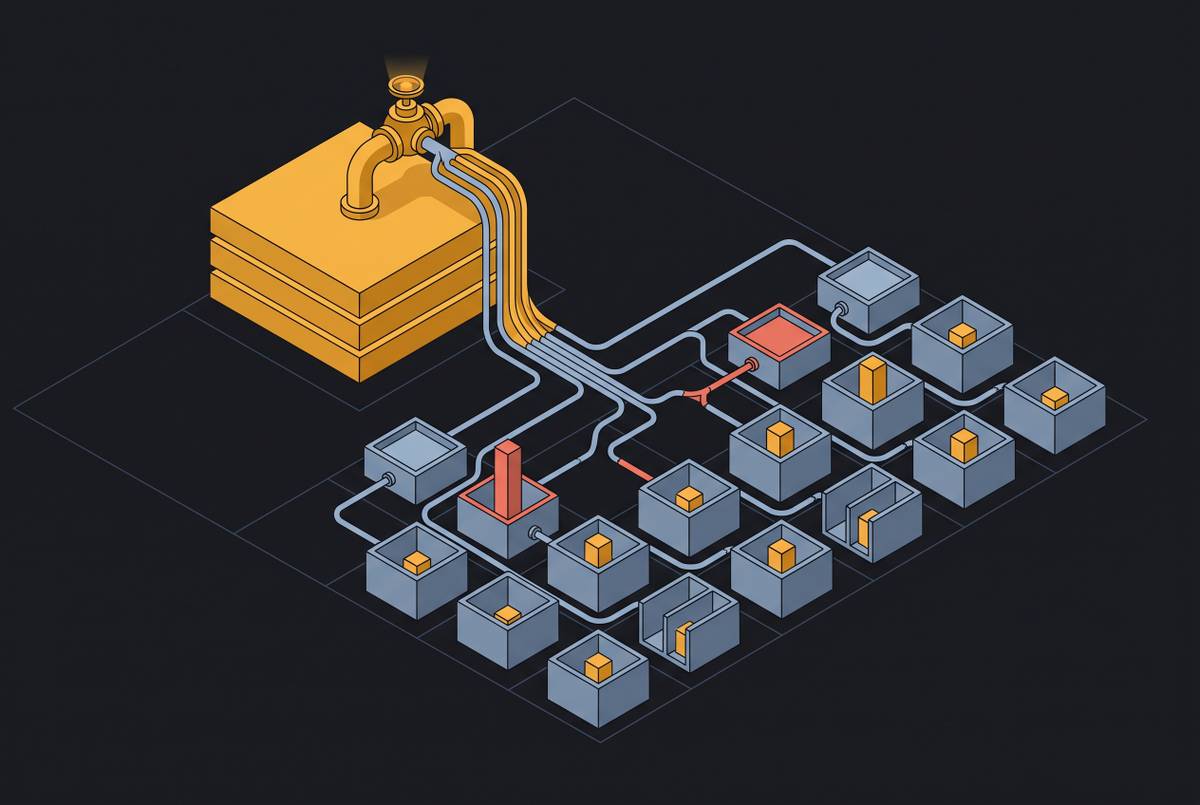
A key-per-repository pattern makes the first split concrete. One provider account may contain dozens of keys spread across repositories, development environments, staging, production, and individual engineers. A key identifies access. When two teams share it, its total cannot explain their respective contributions. When each team has a separate key, finance still needs a rollup that connects those credentials to projects and cost centers.
Adding another provider brings another bill and multiplies the work needed to account for the spend. A team using OpenAI for one workflow and Anthropic for another must reconcile different billing cycles, dashboards, and unit schemas, including token counts shaped by different tokenizers. If it changes model variants mid-month, the same project also spans pricing tiers, with the transition visible only if recorded at request time.
One user action can trigger dozens of separately billed model calls across multiple steps. The provider’s log lacks the parent context that would tie them together. A key inventory alone therefore cannot explain which workflow produced the spend, even when every credential has a named owner.
Why end-of-month reconciliation cannot substitute for real-time attribution
Monthly reconciliation shows what was spent after the chance to step in has passed. A runaway agent loop or misconfigured retry policy can consume a meaningful budget in hours. The reporting interval is longer than the failure. Assigning that expense correctly afterward does not provide the alert or enforcement that could have constrained it.
Reconciliation also depends on an ownership map that billing records do not maintain. Someone must update it when teams change and apply it consistently across providers with incompatible schemas. Even a map kept carefully up to date can connect a shared key’s usage to a department only at the department level when the request context needed to divide usage among its projects was never recorded.
Finance-grade chargeback and budget enforcement need more than a quicker month-end process. Cost needs an owner when it is incurred, while there is still time to act on usage. The architectural consequence is straightforward. Ownership must be established before the request reaches the provider, rather than inferred from the invoice it eventually produces.
What a gateway layer does that direct integration cannot
An LLM gateway sits between applications and model providers, with identity, request context, and cost accounting in one shared control layer. Its position is the essential difference. Every request that crosses it can receive team, project, environment, feature, or customer metadata before forwarding, without each application team implementing an independent tagging system.
The gateway exposes one API surface while handling provider-specific translation underneath. Changing a provider or model can then become a configuration change, leaving application code unchanged. That separation keeps the attribution schema stable as the model mix changes. Organizational ownership no longer depends on the shape of a particular provider’s dashboard.
This accounting requires more than counting requests. Traditional API gateways count calls, but AI spending depends on token consumption and model pricing, so a request-count limit cannot take the place of token-level tracking. The shared layer can also bring agent tool calls and model calls under the same cost and identity model. Without that connection, a system that accounts only for model calls leaves tool-call spending outside its attribution view.
How can teams track AI costs in real time by project, key, model, and provider?
Request-level records need to preserve team, project, virtual key, model, and provider simultaneously. Each dimension answers a different ownership question. Finance may need project totals across providers, while engineering needs to know which models account for a team’s consumption. Recording those dimensions together makes their combinations queryable without repeatedly processing raw logs to reconstruct relationships.
The gateway issues a virtual key to a team or application, maps it to the underlying provider credential it can use, and records cost against that virtual key. Custom metadata can add feature names, environments, or customer segments to the record. Limits enforced by virtual key or team then turn the same attribution data into budget controls in the request path.
Concentrate AI illustrates this pattern with real-time spend tracking by team, project, key, model, and provider through one API covering every major model provider. The useful distinction is the ability to retain internal ownership while querying spend across external providers and models, with request-level cost, latency, and routing information available for investigation.
What spend visibility looks like for engineering, finance, and security stakeholders together
Engineering, finance, and security often approach AI usage through incompatible records. Engineering sees latency and errors, finance gets an invoice, and security has no shared view of access. A common attribution record changes that relationship. Each group can look at the same activity without first working out how the separate dashboards line up.
For engineering, request-level traces identify the model, provider, duration, token count, and cost per call, making unexpected consumption traceable to a workflow or prompt. Finance gains team and project rollups that map to cost centers before invoicing, supporting showback or chargeback without manual reconstruction. Security can review which key accessed which model under which identity.
Gateway controls enforce limits in the request path, trace-level observability explains what happened inside an application, and FinOps platforms allocate spending across clouds, SaaS, and AI. A team may need more than one layer. The distinction is whether its unresolved question concerns enforcement, application behavior, or allocation across the wider technology budget.
Why data security and compliance belong in the same control layer as cost attribution
Sensitive-data governance needs the same chokepoint as cost attribution. PII and PHI redaction, audit logging, and retention policies all need requests to pass through a layer that enforces policy before they reach a model provider. Separate application implementations weaken that consistency. Redaction logic can change from service to service or be left out of a new one, while unmanaged personal accounts bypass corporate controls altogether.
Gateway-level redaction applies one policy across services and produces a centralized record of what was redacted, under which rule, and when. OpenAI retains API data for 30 days by default for abuse monitoring. Zero data retention requires explicit contracting in a Master Service Agreement or Data Processing Addendum, with the gateway enforcing the policy at request level.
For healthcare and other regulated settings, Concentrate AI offers a HIPAA-compliant gateway with PII and PHI redaction, zero data retention, SSO, RBAC, and audit logs. A BAA is available on the paid plan. This implementation brings cost tracking and compliance controls into the shared-layer approach. Both controls depend on the same request path, but each requires its own policy.
How provider reliability failures turn a cost problem into an availability problem — and the same layer fixes both
A direct provider dependency also determines what happens when that provider fails. Without a fallback, errors can become missed user interactions and lost revenue. Accounting cannot restore those interactions afterward. The request path needs a recovery policy as well as a record of consumption.
Automatic failover at the gateway switches to a backup provider or model when the primary returns errors. Because that routing decision lives in policy, recovery does not require application code changes or manual intervention during the incident. The configuration must exist first. Concentrate AI’s built-in fallbacks route across providers serving the same model once a fallback chain has been configured in the routing policy.
That routing function reinforces the attribution architecture rather than sitting apart from it. The same layer that knows the request’s organizational owner also determines which provider serves it and records the resulting spend. Adding sensitive-data controls gives the same layer three roles in production, ownership, governance, and availability. Those roles converge because each requires control before the request leaves the application’s infrastructure.
Build versus buy: what it actually takes to operate this layer yourself
An in-house gateway prototype can hide how much work it takes to run the system in production. The full system needs OAuth, rate limiting across providers, multidimensional per-request cost tracking, failover with correct handling of mid-stream errors, and semantic caching. Each is substantial engineering work on its own. Production readiness is a months-long undertaking.
Self-hosted open-source options still make sense for teams that have the capacity to run the platform. LiteLLM covers a broad provider surface, but production operation requires PostgreSQL and, when running more than one instance, Redis. Its open-source tier has Prometheus metrics, but SSO beyond 5 users and audit logs need the paid enterprise tier. Its Enterprise edition adds governance, security, support, and multi-region capabilities, but teams still host it themselves.
With a managed gateway, the service operator takes care of deployment, patching, scaling, and proxy debugging. Concentrate AI is fully managed, with no proxy for application teams to maintain. Its pricing materials describe token billing without platform markup, but its spend-management terms place conditions on that promise based on plan and volume. The comparison is therefore broader than proxy licensing. It includes the governance features, commercial terms, and ongoing infrastructure work the team is prepared to own.
Getting to real-time attribution before the next invoice: a practical starting point
Make new spending attributable now, without waiting for a perfect reconstruction of old bills. First, inventory provider keys across repositories, CI environments, individual developer accounts, and shared service accounts. The gateway can see only traffic that passes through it. That inventory establishes the boundary the new accounting layer must cover.
Next, define the ownership dimensions before routing traffic through the gateway, including team, product, environment, and customer where needed. Then set virtual-key or team budgets from day one, even conservatively, so enforcement is active before an agent or retry loop creates a surprise. In the same configuration pass, establish what data may reach providers and under which retention terms. Redaction and zero data retention belong in that decision with cost tagging.
Concentrate AI’s pay-as-you-go offering provides a practical managed starting point with attribution, automatic fallbacks, PII and PHI redaction, and zero data retention. A payment method is required to start, and applicable pricing and compliance terms need to match the deployment. The next invoice need not be the trigger. Establishing ownership in the request path now lets useful spend records accumulate before it lands.