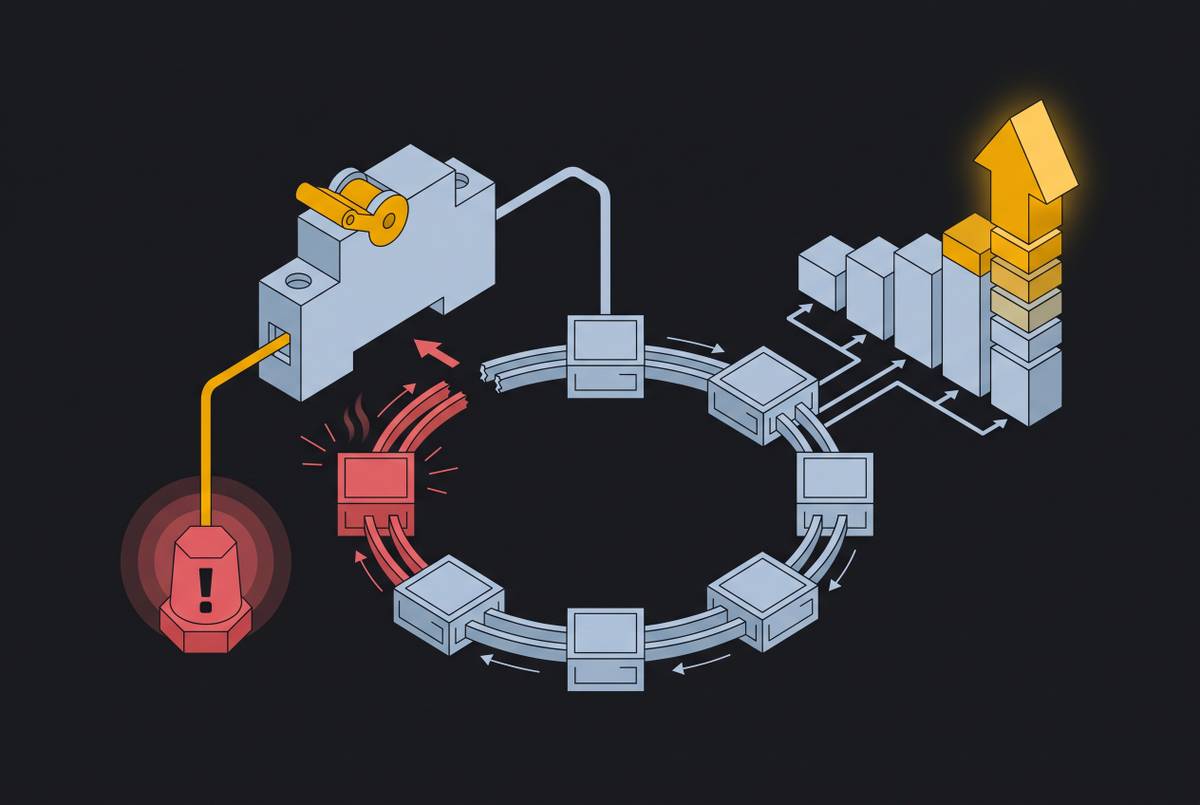
Token-Level Spending Limits Enforced at the Gateway Layer
Gateway-layer enforcement catches expensive requests before they reach your provider.

LLM spending limits have to govern tokens. They also have to act before a call reaches a provider. This article explains why the gateway layer is the right enforcement point, how token-level controls work there, and what separates a real spending limit from a report about money already spent.
Why request-count controls cannot govern AI spending
For traditional REST APIs, one request cost roughly the same as another, so limiting requests per minute or day was a useful way to cap spending. LLMs break that relationship because they bill by token. Two requests to the same endpoint can differ by as much as 100x in cost, while one agentic task can consume as many tokens as thousands of simple chat turns. Counting calls misses the unit being sold.
Request-rate limits still set how fast traffic can arrive. They cannot stop one expensive request from consuming a budget, nor can they show which team or workflow generated the cost. A coding agent makes the mismatch worse because its final token count is unknown until the work completes.
What the gateway layer is and where it sits in the request path
An AI gateway is a reverse proxy between applications or agents and their model providers. A request reaches the gateway first, passes through its policies, and only then reaches the provider. That position gives it control over onward traffic. The gateway gives every caller one shared path where policy applies, while checks in application code are spread across the applications.
Routing, authentication, and policy enforcement happen behind that interface. In 2026, enterprise agentic workloads can turn one user request into a chain of reasoning, classification, retrieval, and verification calls. Those calls may use different models, but the architecture keeps them on the same governed path. The essential condition is that every token passes through one point.
How token-level limits are actually enforced at the gateway before a request reaches a provider
The gateway checks whether a call is allowed before forwarding it. A dashboard records consumption after it happens. That is the dividing line between enforcement and accounting. A report can explain why a pipeline exhausted its budget, but it cannot stop the next call.
Before forwarding a call, the gateway checks it against the rate limits and the budgets it has left. After the call, the gateway adds the tokens it used to the running spending record for later checks. Because the final token count is not known in advance, output-token limits also constrain how much a single call can generate. Pre-call enforcement is a permission decision.
Tokens per minute or requests per window restrain sudden spikes from bugs and loops, while daily, monthly, or billing-cycle budgets constrain cumulative consumption. Both controls are needed to contain spending. Rate limits alone permit slow overruns, while budgets alone let a spike consume the entire allowance quickly.
The budget structure works as nested rings. An organization-wide limit surrounds team pools, which contain project or feature allowances and the virtual keys assigned to applications, developers, or service accounts. Every request must pass all the checks that apply to it, and the tightest binding limit decides whether it goes through. Agent sessions also need a cap on the total used across turns. Zuplo’s AI gateway guide describes hierarchical hard limits and warns that a retry-loop bug can exhaust a monthly budget in minutes.
Why no other layer in the stack can reliably do this job
Application checks can stop calls they control, but their coverage depends on each team implementing them. Every new integration can open a gap. A developer using a personal API key from an unmonitored local environment generates real spend that never appears in organizational tracking. Requiring traffic through a centralized point closes that architectural blind spot.
Provider-side limits remain useful, but they are coarse, per-key controls rather than policies built around internal teams and projects. They also cannot cap what a workflow spends across providers. Reports and invoices show what was spent, but only after the tokens have been used. None of these alternatives supplies universal pre-call enforcement across the organization. A gateway does so only when all traffic is required to use it, making a direct provider call a deliberate bypass.
How real-time cost attribution turns enforcement into operational intelligence
The same request path that enforces budgets can continuously attribute consumption per request by virtual key, team, project, model, and provider. Finance can see costs by team or product line and use that data for chargeback and unit economics. Engineering gets a different view of the same spending. It can identify the workflow driving the burn rate while there is still budget left to change model choice or request volume.
A provider invoice confirms total spend, but it cannot explain which agent session consumed an outsized share of tokens. That distinction also serves security teams, because a spike on one key may signal a runaway agent, a compromised credential, or an unauthorized workflow. The signal needs attribution to become useful. Visibility without enforcement leaves teams watching an overrun, while enforcement without visibility leaves them unable to explain a block. The gateway supplies both from one point.
Token optimization at the gateway layer — reducing spend before enforcing it
A gateway can also reduce the bill it governs. Semantic caching replays a stored response when a new request matches by embedding similarity, avoiding the provider call and its token bill. With provider prompt caching, the call still runs. The gateway marks a repeated prefix as cacheable so the provider can bill it at a discounted cache-read rate. One mechanism removes a call, while the other discounts part of it.
Model routing changes the price of work that still needs a model. The gateway sends simpler tasks to smaller, cheaper models and reserves frontier models for work that needs them. Agent workloads offer another saving through MCP tool-context reduction, which reduces the tool context sent on every turn from every tool schema to a small set of meta-tools. Bifrost’s published benchmark illustrates this mechanism with vendor-published, independently unverified evidence.
Output-token caps constrain runaway generation without requiring each application to set its own limit. These controls target different parts of the bill. Because the mechanisms can stack across applications, the gateway becomes an active cost-reduction layer rather than infrastructure used only to reject requests.
How gateway-layer controls apply differently to agentic workloads than to single-turn calls
Single-turn chat has a more bounded token footprint than an agent carrying out a complex task. An agent can keep calling models across many turns until the task ends or a limit intervenes. Cheap calls can still add up quickly. Per-request caps therefore need session-level or workflow-level budgets to control the cost of the whole job.
The gateway uses a session or virtual key to track the total used across turns. Because the agent returns through that path for every model call, enforcement does not depend on the agent deciding to stop itself. A reasoning model, fast classifier, retrieval model, and verification model can all contribute to one user action’s total cost.
Sending the same tool definitions again adds to the cost across those turns. The tool-context reduction described above cuts that extra input without changes to agent code, while session caps limit how long the agent can keep using tokens. These are distinct controls for the same expanding workload. As agentic use grows, so does the enforcement gap between systems with a gateway in the path and systems without one.
What to look for when evaluating gateway-layer spend controls
For teams evaluating gateways, the first test is whether an over-limit request is blocked or merely logged. A warning is not a spending limit. The next test is scope, including whether limits apply to virtual keys, teams, projects, and the organization. Dollar budgets are easier for finance to interpret, while token quotas require model-specific pricing to translate into spend. Either unit can be useful, but its meaning must be clear.
Attribution and accountability need their own examination. Every request should be attributable to its key, team, project, and model, with current burn rate visible before the billing cycle closes. Policy changes need an audit trail showing who raised a budget, created a key, or removed a limit. Agent sessions need cumulative tracking across turns. These tests distinguish enforceable governance from a detailed usage ledger.
Bifrost, an open-source gateway by Maxim AI, enforces dollar budgets at four nested levels, namely customer, team, virtual key, and provider config. It blocks exhausted budgets with HTTP 402 and provides cryptographically signed audit logs in a self-hosted system. Cloudflare AI Gateway added spend limits in June 2026, with rules scoped by model, provider, or custom metadata such as team or user ID. Over-limit requests receive HTTP 429, or dynamic routing can send work to a cheaper model. The scope and response differ between these options.
Azure API Management’s generally available llm-token-limit policy enforces tokens-per-minute limits or quotas over hourly, daily, weekly, monthly, or yearly periods. Translating those quotas into team dollar budgets requires pricing each model separately. Its August 2026 AI Gateway tier preview added a dollar-based Cost limit policy per API key and model, partially addressing that distinction. No nested team budget hierarchy is published.
LiteLLM provides a provider-compatible interface across providers, with virtual keys and spend tracking in its open-source build. SSO is free for up to 5 users, with Enterprise required beyond that, while audit and RBAC sit in the paid tier. The March 24, 2026 PyPI compromise gives teams a reason to check version control when they deploy it. Teams self-hosting it are advised to pin commits or specific releases. Zuplo, meanwhile, offers a dedicated AI Gateway project type with per-user or per-application token rate limits and automatically enforced daily and monthly budgets at organization, team, and application levels.
Putting gateway-layer enforcement in place without rebuilding the application stack
For teams moving from direct provider calls to a provider-compatible gateway, compatible applications can start by changing their base URL and keeping their application logic. Credentials are the next part of the move. Teams can issue virtual keys for each team, project, and application, then remove shared raw provider keys from application code. Rate limits and budgets can start at the virtual-key level, and teams can add team and organization limits as it becomes clear who owns what.
The first billing cycle then provides a baseline. Attribution logs show which workloads spend the most and where limits need to be tighter. Caching and model routing can follow once that baseline is understood, keeping it clear from the start. Self-hosting adds infrastructure to operate, update, and secure, while a managed gateway reduces that burden but requires trust in the provider’s security posture.
Teams also need to weigh their governance requirements when they make that choice. Many open-source gateways reserve SSO, RBAC, and audit logs for paid tiers, so teams should assess whether they need those controls on day one. In regulated environments, the same request path can apply PII and PHI redaction before data reaches a model provider, and contracts for managed arrangements can set out how protected health information is handled to help meet HIPAA obligations. The first three steps remain concrete, namely redirect traffic, issue virtual keys, and set initial limits. Once the gateway is the required chokepoint, spend, security, and reliability controls become policies, reducing repeated application-code changes.