Building an Internal LLM Evaluation Suite Without a Dedicated ML Team
Product teams can own LLM evaluation with operational rigor, not ML expertise.
Product engineering teams now own LLM evaluation, and most of them didn't choose the job. A team that ships a feature built on a large language model but never checks whether that model's output still meets the bar it set on day one is running blind, and the drift that follows stays invisible until a customer notices first.
Evaluation got handed to product teams the way logging and alerting did, out of necessity. Both paths leave the team exposed the moment a provider changes model behavior, pushes a silent update, or retires an endpoint. None of those events send a warning first.
The fix starts with a reframe. Evaluation isn't a research discipline that requires an advanced degree or a specialized background. It belongs in the same category as logging, alerting, and rate-limit handling: operational infrastructure that keeps a system honest about its own behavior. Product engineers already build and maintain that kind of infrastructure every day. Evaluation asks for the same skill set, pointed at a new kind of output.
What "production-grade" LLM evaluation means for a product team
Production-grade evaluation, for a team without ML specialists, comes down to three measurements: cost per request, latency per request, and task-specific output quality. Nothing else needs to make the first cut.
An ML researcher evaluating a model cares about generalization, emergent capability, and how one model stacks up against another on a shared benchmark. A product team doesn't need any of that to ship a reliable feature. What a product team needs to know is narrower and more useful: does this response meet the contract the feature requires, right now, at the cost and speed the team can afford. That's a different question, and it's one a team can answer without a research background.
Cost and latency give a precise, numeric floor to work from. Latency needs more than an average. An average can look fine while a meaningful share of requests stall long enough to ruin the experience.
Output quality gets defined by the team, against the feature it's actually building. A code generation task needs to pass the project's test suite. None of that calls for a generic benchmark score.
Some things belong off the list entirely, at least at the start. A team without that expertise gains little by taking them on early, and the time spent trying usually comes at the cost of the three measurements that actually matter.
The clearest way to think about eval metrics is the same way a team already thinks about API service-level objectives. A threshold gets set. A request either clears it or it doesn't. Checks run automatically, and a failure triggers a response the same way an SLO breach would. That's a judgment the system renders on its own, not one an engineer has to sit down and render by hand after every deploy.
Why evaluation belongs at the gateway layer
Every piece of data an evaluation suite needs already passes through the gateway. A separate evaluation platform doesn't add new data. It adds a new place to go looking for data that's already sitting somewhere else.
A typical gateway request moves through authentication, a policy check, a cache lookup, a routing decision, the provider call itself, a response transform, and a metrics emission step. Every one of those calls is instrumented already. An evaluation check is a filter placed on that existing stream, not a new pipeline built alongside it.
Routing and evaluation are tied together in a way that's easy to miss until it causes a problem. Latency-based routing is only safe once quality equivalence between candidate models has been checked. Cost-based routing only works if the team knows the cheaper model still satisfies the same output contract as the one it's replacing. Routing decisions get made at the gateway. If evaluation lives somewhere else, the two systems have no way to talk to each other, and routing ends up making decisions with no quality signal behind them.
A separate ML experiment platform brings its own weight. For a team without dedicated ML capacity, that cost adds up faster than the platform pays for itself.
The pattern that actually works treats evaluation as a sidecar attached to the gateway's response flow. After a response comes back, it gets compared against the task contract: length, format, whether it matches a required enum, whether it passes a test. All three numbers land on one dashboard, generated by one system, maintained by the team that's already maintaining the gateway.
Defining task-specific output contracts before writing a single eval check
Most LLM evaluation suites fail for a reason that has nothing to do with which tool the team picked. They fail because no one wrote down, in specific and testable terms, what a correct output actually looks like. Without that definition, eval checks end up measuring something, just not anything the team can act on.
An output contract names what counts as correct for a given task. Format: JSON with a specific set of keys, an enum value drawn from a fixed list, markdown that follows a set of rules. Downstream compatibility: the response has to pass a parser, or pass a test suite waiting on the other end.
Contracts get written per use case, not per model. A summarization task has one contract. A classification task has a different one. A code generation task has a third. The same model can meet the bar on one of these and miss it on another. The contract has to attach to the task rather than to whichever model happens to be serving it.
The order matters here. Write the contract first, then build the check that tests it. Teams that start by instrumenting everything and figure out the contract later tend to end up with metrics describing how a model behaves in general, rather than whether the feature built on top of it actually works.
Contracts double as regression tests once they exist. When a provider updates a model, or the team decides to switch providers, running the existing contract suite against the new model gives an immediate answer: safe to ship, or not. No one has to sit down and manually review a batch of outputs to find out.
Not every feature needs a contract on day one. Start with the ones that cost the most, carry the heaviest consequences for users, or sit behind providers that change models the most often. Those are the features where a regression turns into a production incident fastest, which makes them the ones where writing the contract pays off soonest.
Building the evaluation check as a CI/CD step rather than a manual review process
A failing output contract should block a deploy the same way a failing unit test does. That single decision is what keeps evaluation alive past the first week. Without it, evaluation turns into a one-time audit that quietly goes stale the moment the team ships the next feature.
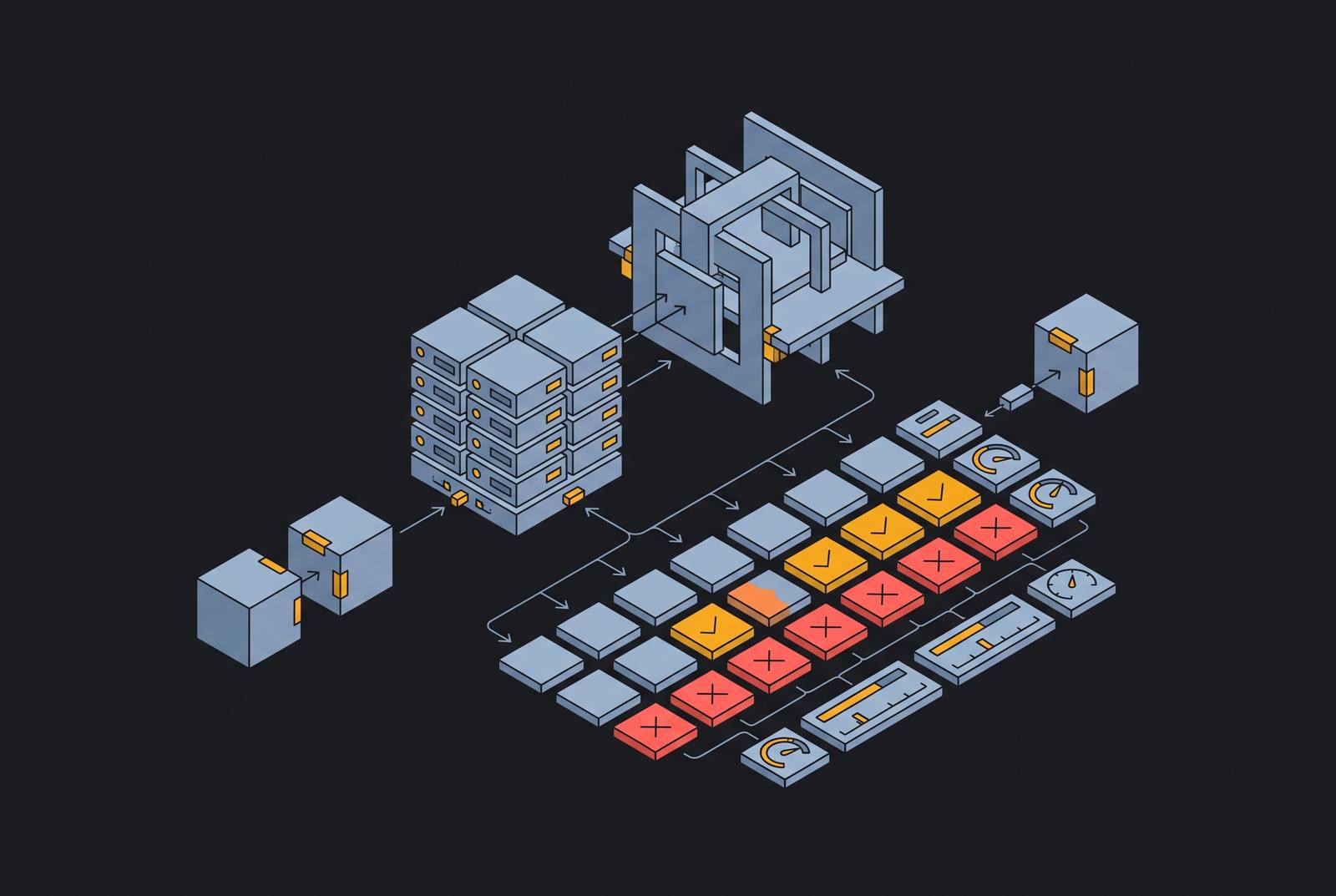
The mechanics look a lot like a familiar test suite. A fixed set of representative prompts, the eval set, runs against the target model on every pull request or before every deploy. Each test checks the response against its output contract. If a response fails, the deploy stops.
The eval set itself should come from real traffic, not prompts someone invented for the occasion. The team should pull from those logs when building the set, picking out the edge cases: inputs sensitive to format, inputs that have caused regressions before, anything that sits near the boundary of what the contract allows.
Cost and latency assertions belong in the same CI step as quality assertions, not off in a separate check somewhere. A deploy that pushes average cost per request past an agreed threshold is a regression, even if the output itself still looks fine. The contract should cover all three dimensions at once, because a team that only checks quality can still ship a deploy that quietly doubles the bill.
The gateway's model registry and alias system make all of this testable across providers without rewriting tests every time something changes underneath. Tests run against an alias, something like "chat-fast," and the registry resolves that alias to whatever model is currently serving it. The existing test suite validates it automatically, instead of requiring new tests written for the new model.
Some tasks genuinely resist a strict contract, and a team facing open-ended outputs might reasonably ask whether any of this applies to them. It starts with the subset of tasks that already produce structured output: classification, extraction, code generation, JSON formatting. Those cover a meaningful share of what most product teams actually ship with an LLM behind it. Writing contracts for that subset builds the habit and the infrastructure the team will need before it tackles the harder, more open-ended cases.
Using gateway observability to run continuous evaluation in production, not just pre-deploy
CI evaluation catches a regression before it ships. It cannot catch the regressions that show up without a deploy at all: a provider changing a model behind a stable endpoint, behavior drifting gradually over weeks, quality degrading only once the system hits real load.
A provider can swap the model behind an API endpoint without changing its name and without issuing any deprecation notice. Nothing in a CI pipeline catches that, because nothing gets redeployed. The only way to catch it is to keep checking live traffic, and gateway logs will show the shift in output distribution before any alert fires, as long as the team is sampling and checking responses as they come in.
The pattern itself is simple. Log a fraction of production responses, something the gateway is already doing. Run the same output contract checks against that sample asynchronously, outside the request path so it adds no latency to the user. Emit pass or fail metrics to the same dashboard already holding cost and latency. A drop in the pass rate is the signal: something changed, and it needs a look.
Alert thresholds should mirror the CI contract exactly. The team defines the contract once, and that one definition governs both the pre-deploy gate and the live monitor.
Cost and latency tracking at this layer does double duty. It functions as an operational SLO, the kind of thing an on-call engineer watches regardless of what model sits behind a feature. It also functions as an evaluation signal in its own right. A sudden jump in average tokens per response often points to a prompt change or a model swap, and that same change has frequently affected output quality too. The two numbers rarely move independently.
Routing decisions that require evaluation data
Routing based on latency or cost both depend on evaluation data that has to exist before the routing rule gets turned on. Flip either one on without that data, and output quality gets traded away for speed or savings the team has no way to measure or justify.
Without that check, the routing rule is a guess dressed up as a policy.
The failure is visible in a specific pattern: a team turns on latency-based routing to shave down p95 response time, and the team watches latency, which looks great. The team is watching latency, which looks great. Nothing is watching quality, so nothing fires.
Tiered fallback, where a capable model gets tried first and a cheaper model catches the failures, carries the same risk. It's only safe once the cheaper model has been checked against the same contract as the primary. When that step is skipped, the fallback path delivers a degraded response precisely when conditions are already bad: provider pressure, a traffic spike, exactly the moment the team has the least time to investigate what went wrong.
The sequence that keeps this safe is straightforward. Run the eval suite against every model in a planned fallback chain before switching the chain on in production. Promote a model to primary only after it clears the quality contract on the eval set. Use the production sampling monitor to confirm quality holds once the model is handling real traffic at real volume, before pulling the previous primary out of the fallback list.
A minimum viable evaluation suite for day one
A team starting from zero doesn't need all of this running at once. The sequence matters more than the completeness.
Start by writing output contracts for the two or three features that carry the highest cost, the most user-facing risk, or the most frequent provider changes. Keep the first contracts narrow and structured: classification, extraction, JSON formatting, code generation. These are the tasks where a pass or fail is unambiguous, and they're where the habit of writing contracts gets built fastest.
Wire those contracts into a CI step before anything else. Add cost and latency thresholds to that same CI step immediately, since a regression in either one matters as much as a drop in output quality.
Once the CI gate is running, extend the same contracts into production. Set the production alert threshold to match the CI threshold, so the team enforces one standard everywhere.
Only after that foundation is in place should a team turn on cost-based or latency-based routing, and only for models that have already cleared the relevant contracts. The same rule applies to any fallback chain: every candidate model gets tested against its contract before it's allowed to carry live traffic.
From there, growth is additive. More features get contracts. More fallback paths get coverage. Harder, more open-ended tasks get tackled once the structured ones are solid. None of it requires an ML specialist to build, and none of it requires a second platform running alongside the gateway the team already has. It requires writing down what correct looks like, and checking for it automatically, every time.