What Provider Outages Actually Cost and How Fallback Routing Caps the Spend Damage
Fallback routing at the infrastructure layer protects against provider outages and runaway costs.
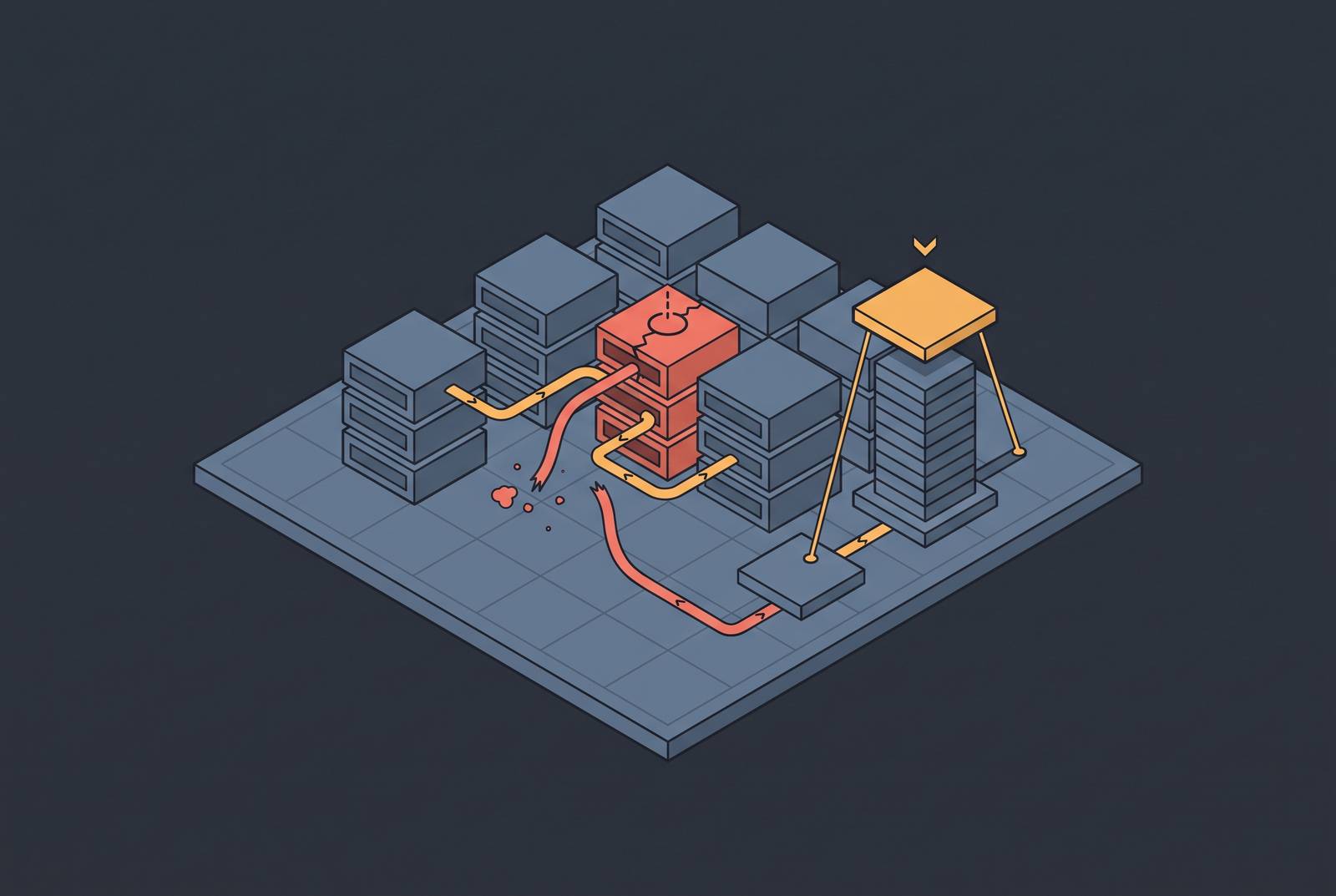
Provider outages cost more than the minutes a service is unavailable. They stop work, drive up spend through degraded retries, and force engineers to make emergency repairs. Fallback routing at the infrastructure layer caps all three together by putting reliability and cost policy at one control point. Its value depends on both the routing rules and the preparation behind them.
Why LLM APIs fail more often than the infrastructure around them
A model provider is a less reliable production dependency than the infrastructure teams are used to building around. OpenAI logged repeated incidents across a single month, nearly one every few days, with a prior outage lasting several hours across its API, ChatGPT, and Sora. That record makes provider failure a routine design concern. The Nordic APIs 2026 report notes that Stripe and Linear both run at uptime figures that round to four nines. Teams building on model providers cannot count on that level of uptime.
Availability figures also miss failures that look healthy from the outside. An API can return 200 OK while the output is wrong, slow, or truncated. A passing health check conceals the application’s inability to do useful work with the response, making this degraded state harder to catch than a clean refusal because the signal says “up”.
Nor does the provider itself have to break. A failure in cloud networking or a CDN can cascade into the model service and take it down. The application therefore depends on more than the provider’s own operation. Its reliability plan has to cover both obvious outages and responses that arrive successfully but fail the task.
The three cost mechanisms an outage triggers simultaneously
An outage starts three separate bills at once, including direct productivity loss, runaway spend from degraded retries, and emergency engineering overhead. Work stops or slows while the application waits for an answer it can use. At the same time, trying again can use up quota and tokens without getting a better result. Engineers then spend time diagnosing the problem and repairing the path through it. Counting only downtime minutes leaves the other two bills out.
A provider that keeps returning malformed output to an agent that keeps trying again can pose the sharpest spend risk. Such a loop can amplify consumption even while ordinary error monitoring sees successful responses. An availability-only circuit breaker has no reason to stop that pattern unless bad output is also treated as failure. A separate cost threshold is needed to bound what the loop can spend.
These mechanisms compound because stopping one does not automatically stop the others. Switching to a more expensive model can get work going again while driving up the bill. An alert can show that spend is rising without giving engineers a fallback path that works. The controls therefore need to cover continuity, consumption, and automatic mitigation together. Scattered controls cannot reliably act as one policy.
Why application-level retry logic and hand-wired fallback fail to cap the damage
Retry with exponential backoff is useful for a short-lived problem. It can handle 429s and brief network glitches that clear in seconds. But when an outage lasts longer, trying again does not bring the provider back sooner. Retries can instead consume quota and burn tokens where degraded responses continue to arrive. Backoff spaces out attempts, but it does not supply a working alternative or a spending limit.
Hand-coded fallback supplies that alternative, but usually without the rest of the controls. A service can switch providers without knowing if the new one goes over a cost threshold. Prompts tuned for the original model may produce worse output, and different tool-calling semantics can break JSON schemas. As providers update APIs, teams have to do more work to keep those fallback chains up to date across many services.
Each service makes its own decisions on reliability, while cost policy and observability sit elsewhere. Teams behave differently, and finance and security stakeholders lack a shared view of what those decisions do. Application-level controls may soften one part of an outage, but they do not put all three costs under a single boundary.
How fallback routing at the infrastructure layer caps all three cost mechanisms
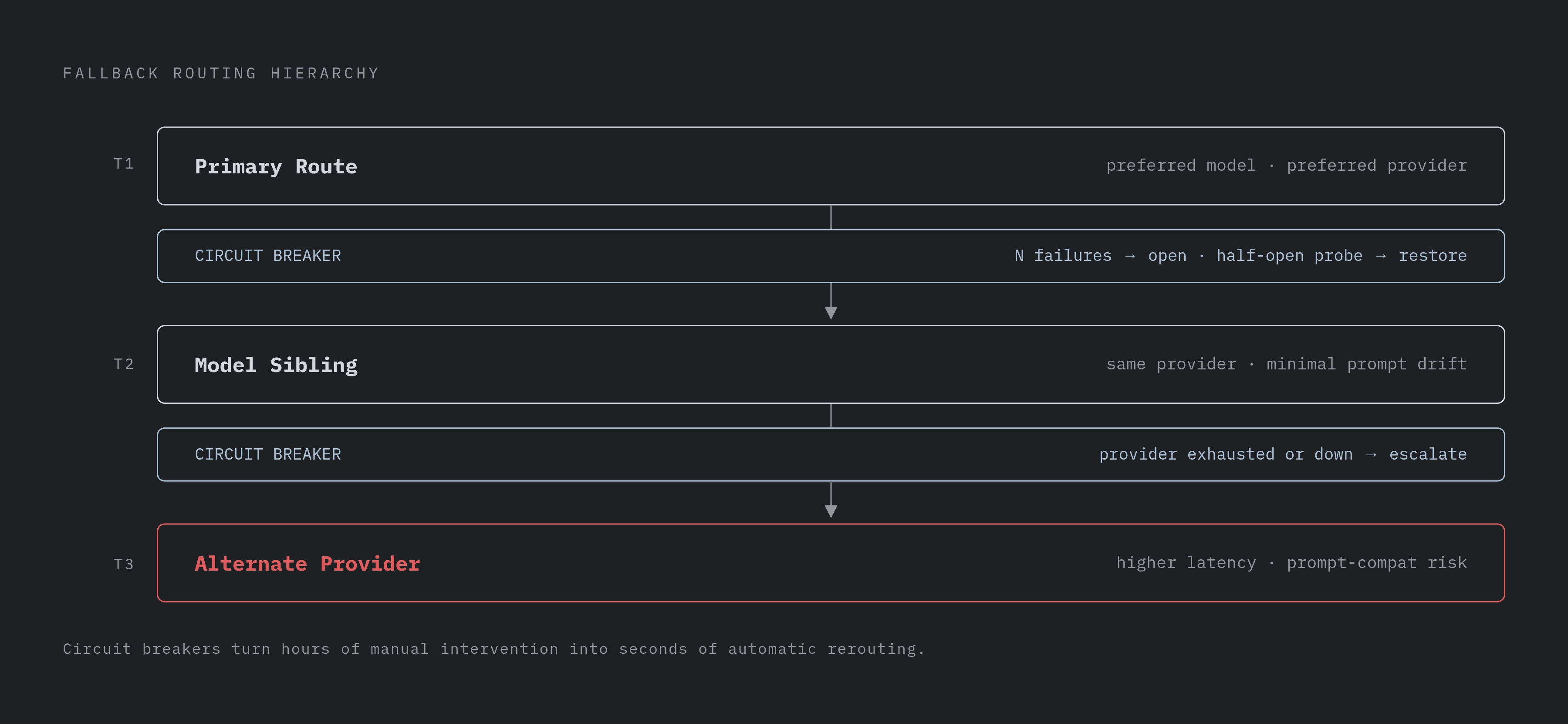
A gateway moves routing, fallback, circuit breaking, and spend policy behind one interface. It uses a shared configuration for the requests that pass through it, so each application no longer has to bring those controls together. Useful work can continue, repeated failures can be cut off, and spending limits can follow the traffic. Automatic routing also removes the need for an emergency code change just to reach the next provider.
The fallback tiers keep that response proportionate to the failure. Tier 1 is the primary route. Tier 2 uses a cheaper or faster model sibling from the same provider, which keeps the same tokenizer family and tool-calling conventions with very little prompt drift. That avoids crossing providers for a brief rate-limit event. Tier 3 moves to a different provider only when the earlier tiers are exhausted or the whole provider is clearly down, accepting the greater latency and prompt-compatibility risk.
Circuit breakers keep the tier system from making every request repeat the same failed experiment. With them, the circuit opens after N consecutive failures and skips that tier while it remains open. Michael Nygard’s Release It!, 2007, describes the standard half-open pattern in which a single probe request tests recovery. This lets mitigation move from hours of manual intervention, code changes, and redeployment to seconds as the next request routes automatically.
Spend policy then travels with that routing decision. Token-aware quotas track consumption across requests and responses by team, key, or project. Per-provider thresholds can trigger an alert or hard stop when a more expensive fallback starts multiplying spend. These controls also address repeated consumption from malformed responses, which an availability check alone can miss. A fallback is therefore an allowed route within a budget.
Per-request observability makes those rules visible to the teams responsible for them. Security teams can audit prompts and responses, cost teams can query token consumption by department, and compliance teams can verify that PII masking ran before external calls. The gateway does not eliminate prompt-compatibility work, however. Tools still need a common schema with translation at the adapter layer. Every response also needs schema validation, with validation failure treated as a router failure signal.
What effective uptime and spend outcomes look like with fallback routing in place
The intended outcome is effective application uptime above what any one provider can support alone. That follows from having another usable route rather than waiting for the primary provider to recover. The evidence supplied here supports the resilience approach, but it does not establish a named team’s achieved uptime. The Nordic APIs Reliability Report shows how uptime varied across 215+ AI and cloud services from October 2025–February 2026. It recommends multi-provider fallback, circuit breakers, and cached responses, but does not document a specific team’s four-rung fallback architecture or a named uptime figure.
Latency is the strongest reason to question adding another layer. Maxim AI’s Bifrost documentation reports per-request overhead measured in microseconds in production benchmarks. That is not a meaningful trade-off against the 8-second waits a dead provider can impose without circuit breakers. The relevant comparison is therefore not merely gateway versus no gateway. It is the gateway’s small processing cost against the delay of repeatedly trying a failed route.
The spend outcome is more direct than an uptime claim. Thresholds configured at the gateway apply across services and teams using that route, closing the gap left by separate service configurations. An alert exposes rising cost, while a hard stop bounds consumption under the configured policy. Neither makes an outage free, but both prevent recovery from becoming an unchecked spending decision.
Routing for cost efficiency during normal operation, not just during outages
The same infrastructure can do two jobs, namely outage resilience and continuous cost control. During an incident, routing finds another route that works and fits the policy. During normal operation, it sends each request to the cheapest model capable of doing the work. The routing policy makes the choice, and output validation checks the result.
The DEV Community analysis describes a wide price gap between frontier and budget models and suggests a way to group tasks. Tier 0 covers trivial work such as keyword extraction, formatting, and simple classification, routed to the cheapest capable model. Tier 1 covers standard tasks such as summarization, structured Q&A, and short content generation, routed to mid-tier models. Tier 2 sends multi-step reasoning, long-context analysis, and code generation to flagship models. Tier 3 reserves a flagship model plus a verification pass for adversarial or high-stakes tasks where errors are expensive.
The DEV Community analysis reports that multi-model routing cut production costs by a large amount with no measurable drop in quality. That does not remove the risk of choosing a model that is too weak for the task. Sending too much work to cheap models can make the bill look good while quality drops without anyone noticing. Output validation gives routing a signal when responses fall short, the same safeguard it provides during outages.
Managed gateway versus self-hosted open-source: choosing on total cost, not sticker price
The choice between a managed gateway and self-hosted open-source software is a total-cost decision. Licensing price is only one part of it. Engineering time, on-call load, compliance overhead, and operational risk remain part of the bill whichever route a team chooses. A gateway is supposed to reduce the work and waste surrounding provider failures.
LiteLLM anchors the self-hosted option as an open-source default with 33,800+ GitHub stars. The cost calculation still has to include upgrades, Redis, Postgres, and monitoring, as well as the people who keep the system running. Self-hosting puts those costs into the team’s operating workload.
A fully managed gateway typically has lower total cost for smaller and mid-sized teams once those obligations are included. The operating model needs to deliver the shared controls while preserving the savings after maintenance and on-call work.
Building the runbook: what teams need before the next incident, not after
Fallback routing supplies the mechanism, but a runbook makes it operational. Teams need rules for detection, triage, and communication before a provider fails. Otherwise, the gateway may limit some damage while engineers still scramble to work out what happened and who needs to know. Detection must account for both unusable output and failed requests. The same validation signal that guides routing also makes degraded quality visible.
Triage should begin with blast radius. Teams need to identify which production features depend on the affected provider, whether those features can degrade gracefully, and whether they have configured fallbacks. Most teams still have no way to answer those readiness questions automatically. Answering them before an incident avoids making dependency discovery part of the emergency. Communication protocols then give the response a defined path.
Spend controls complete that preparation. Per-provider cost thresholds at the gateway should trigger an alert before a move to a more expensive model multiplies daily spend. Where a hard stop is configured, the runbook needs to account for that limit as part of the fallback path. Readiness means knowing both where requests will go and what that decision is allowed to cost. The dividing line is between teams that have tested their fallback path and teams that discover it for the first time during an incident.